Geology is the study of the earth and all aspects of rocks and minerals, both solid and molten, on earth and beyond, extending into the solar system as far as we can go or see.
The study of geology is made up of the following disciplines: Igneous petrology, Metamorphic petrology (including alteration & metasomatism), Sedimentology, Structural geology, Mineralogy, Crystallography, Ore/Economic geology, Petrography, Geochemistry, Geophysics, Palaeontology.
1. Rocks
Rocks are naturally occurring solid masses or aggregates of minerals that make up planetary crust. Minerals are mostly chemical compounds, a very few being native elements.
Rocks are divided into three groups, Igneous, Metamorphic and Sedimentary.
1.1 Igneous Rocks form from the cooling of molten magma or lava, which originates from both the mantle and deep crust. They are divided into intrusive or plutonic, extrusive or volcanic, and hypabyssal. All igneous rocks are composed of three essential minerals in different proportions. Other minerals that occur are known as accessory minerals (see later in rock classification).
Plutonic rocks form from magma that does not break through the crust but settles somewhere fairly deep within it. It cools slowly and produces rocks made up of medium to coarse grained crystalline minerals. Chemically these rocks are classified as ultramafic (high Mg and Fe and very low SiO2, dark coloured, eg pyroxenite), mafic (high Mg and Fe and low SiO2, dark and light coloured, eg gabbro), intermediate (medium SiO2 and a mixture of dark and light coloured minerals, eg diorite), and felsic (high SiO2 and mostly light coloured minerals, eg granite).
Volcanic rocks form from magma that is extruded through the crust and onto the surface of the earth. It cools quickly and forms very fine grained rocks. They share the same chemistry as plutonic rocks, ultramafic eg komatiite, mafic eg basalt. intermediate eg andesite, felsic eg rhyolite.
Hypabyssal (or sub volcanic) rocks are in between and originate from offshoots from magmatic plutons and volcanic vents. They do not extrude onto the surface, but crystallize within the crust but at shallower depths than plutonic rocks. They often form dykes and sills and are fine to medium grained. Their chemistry extends from mafic to felsic, eg dolerite, granophyre.
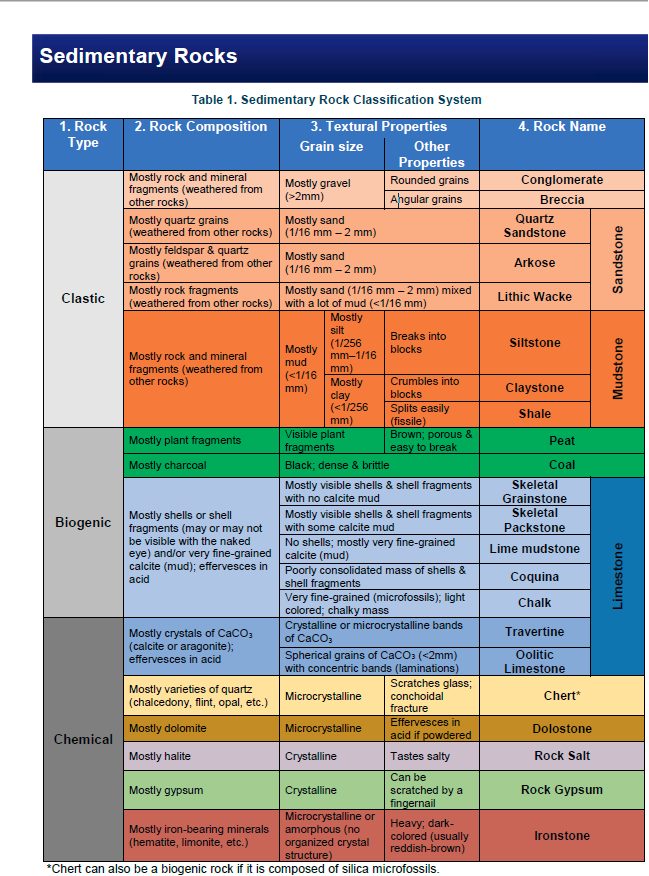
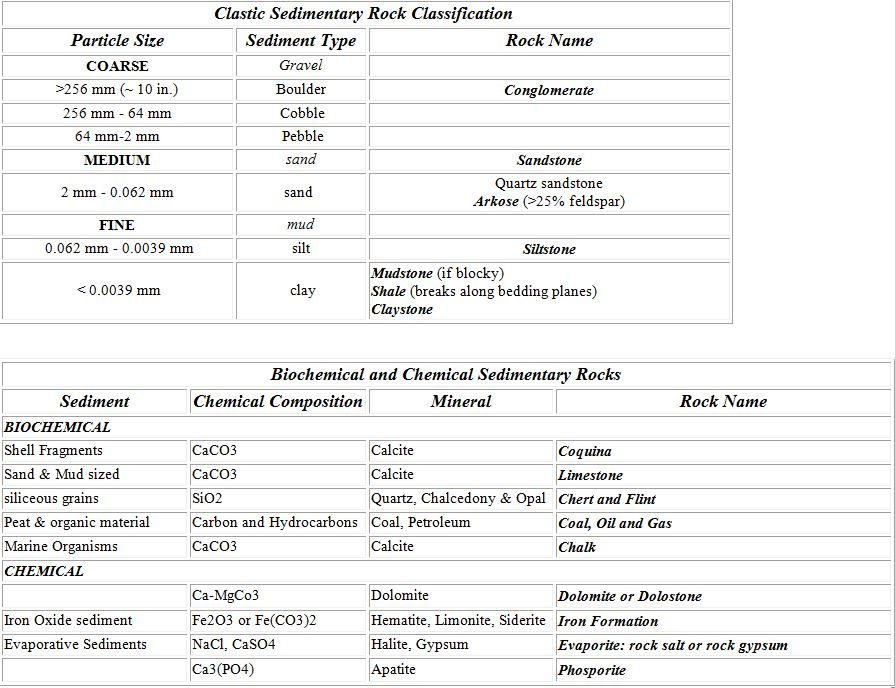
1.2 Sedimentary Rocks are formed at or near the surface. They are divided into clastic, chemical, and biogenic, as shown in the following table.
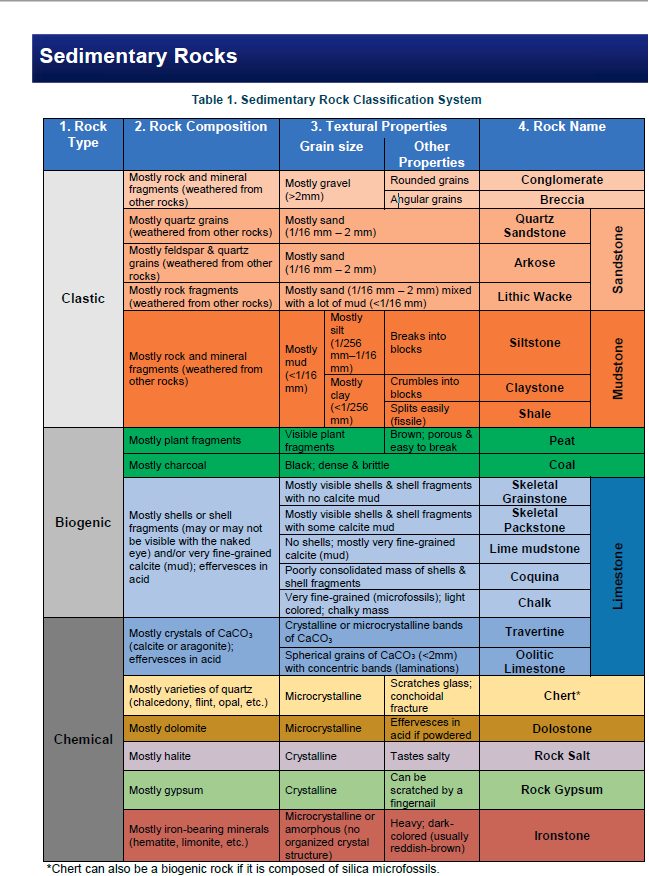
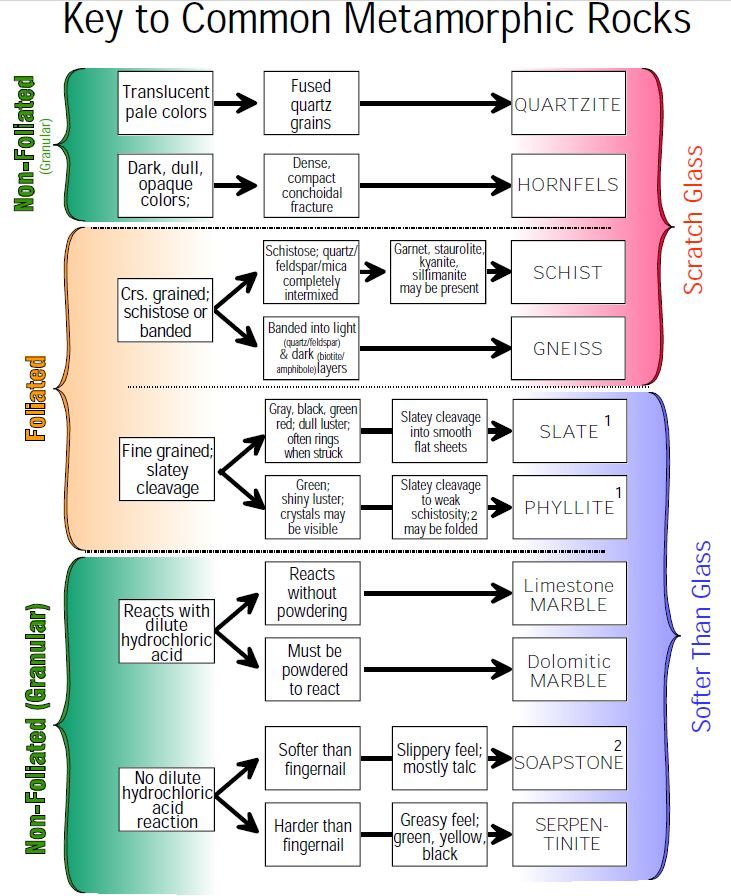
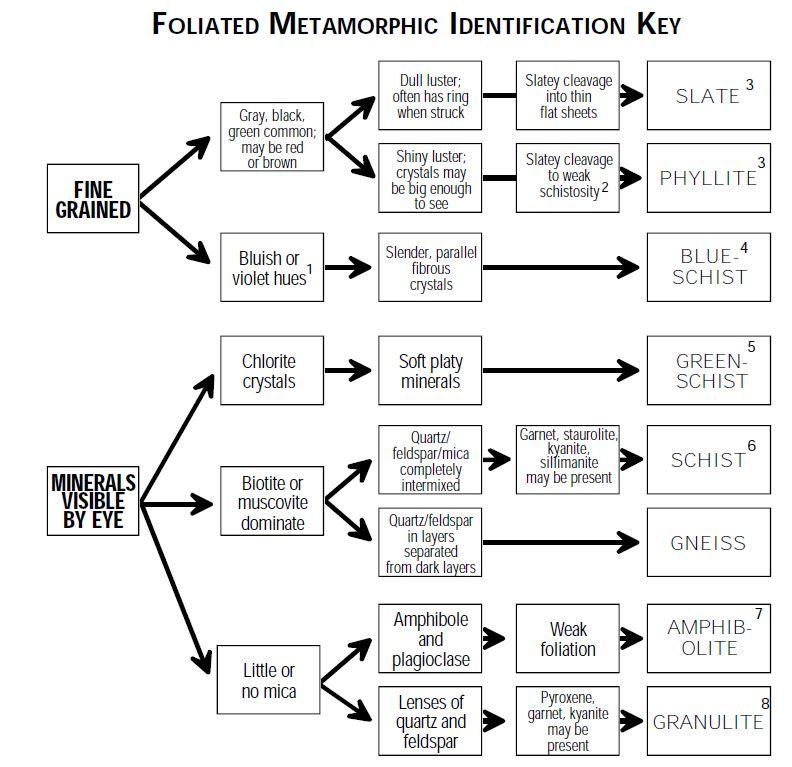
1.3 Metamorphic Rocks are formed when pre-existing, igneous, sedimentary or older metamorphic rocks are transformed by high heat and pressure, and hot hydrothermal fluids. These processes alter the mineralogy and texture of rock without melting it to any significant extent. Metamorphic rocks are divided into foliated (eg slate, phyllite, schist, gneiss) and non-foliated (eg quartzite, marble, serpentinite).
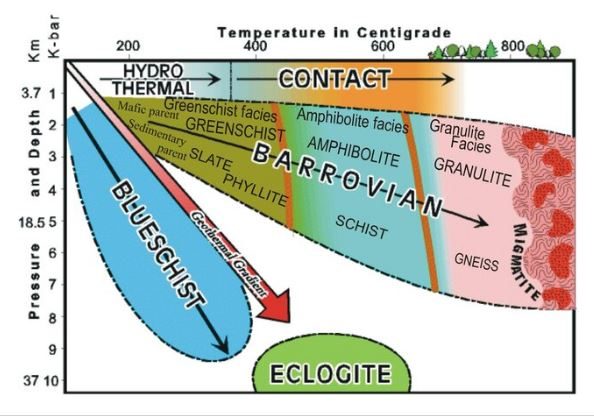
1.3.1 Metamorphic Facies
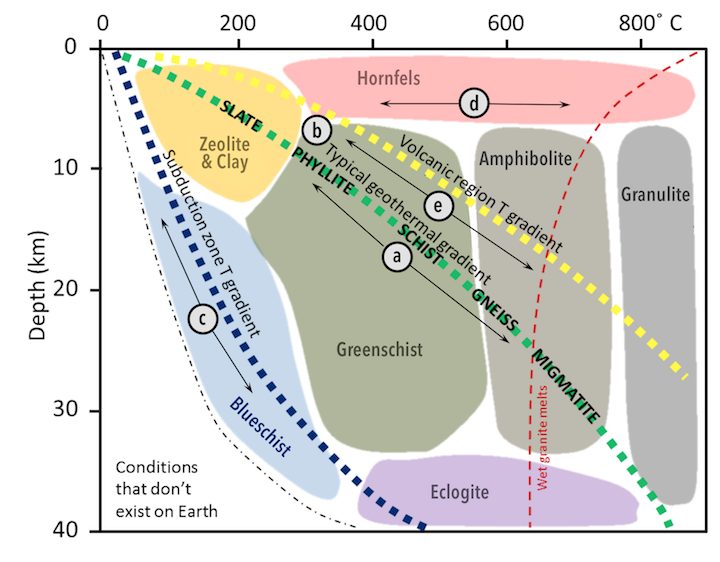
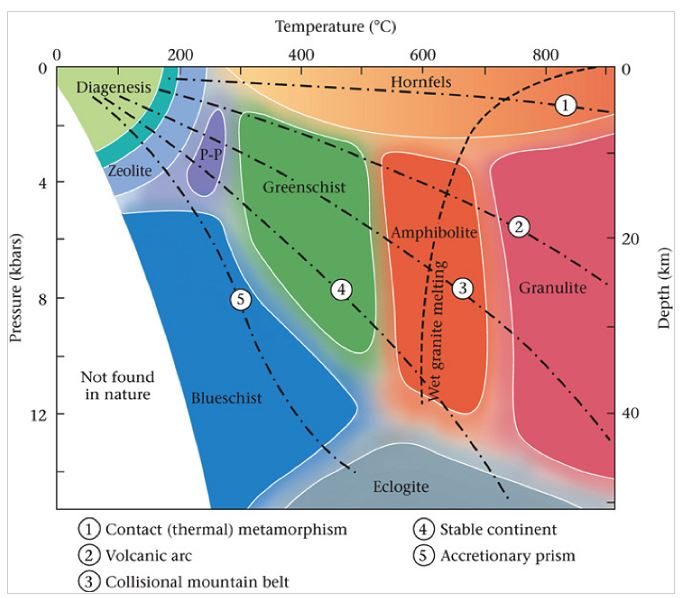
A metamorphic facies is a group of mineral assemblages formed under similar pressure-temperature (P-T) conditions. Facies help geologists determine the metamorphic environment experienced by a rock.
1.3.1.1 Greenschist facies
- Low-grade metamorphism.
- Temperature: approximately 300–500°C.
- Characterized by chlorite, epidote, actinolite, and albite.
- Common rocks: slate, phyllite, and low-grade schist.
1.3.1.2 Amphibolite facies
- Intermediate-grade metamorphism.
- Temperature: approximately 500–700°C.
- Dominated by amphibole and plagioclase feldspar.
- Produces schist and amphibolite.
1.3.1.3 Granulite facies
- High-grade metamorphism.
- Temperature: generally above 700°C.
- Characterized by pyroxene and feldspar.
- Commonly associated with deep crustal conditions.
1.3.1.4 Blueschist facies
- High-pressure, low-temperature metamorphism.
- Typical of subduction zones.
- Contains minerals such as glaucophane.
- Indicates rapid burial of oceanic crust.
1.3.1.5 Eclogite facies
- Very high-pressure metamorphism.
- Characterized by garnet and omphacite.
- Forms at great depths within subduction zones.
- Represents some of the most extreme metamorphic conditions.
1.3.2 Metamorphic Grade
Metamorphic grade refers to the intensity of metamorphism.
1.3.2.1 Low-grade metamorphism
- Low temperature and pressure.
- Produces slate and phyllite.
- Minerals include chlorite and muscovite.
1.3.2.2 Intermediate-grade metamorphism
- Moderate temperature and pressure.
- Produces schist.
- Garnet and staurolite commonly appear.
1.3.2.3 High-grade metamorphism
- High temperature and pressure.
- Produces gneiss and migmatite.
- Sillimanite and pyroxene may develop.
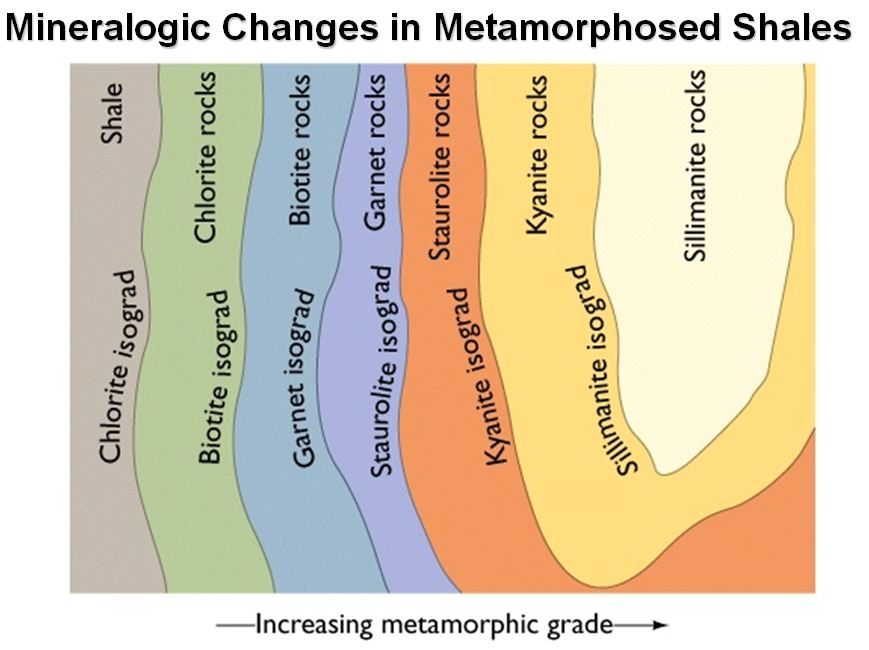
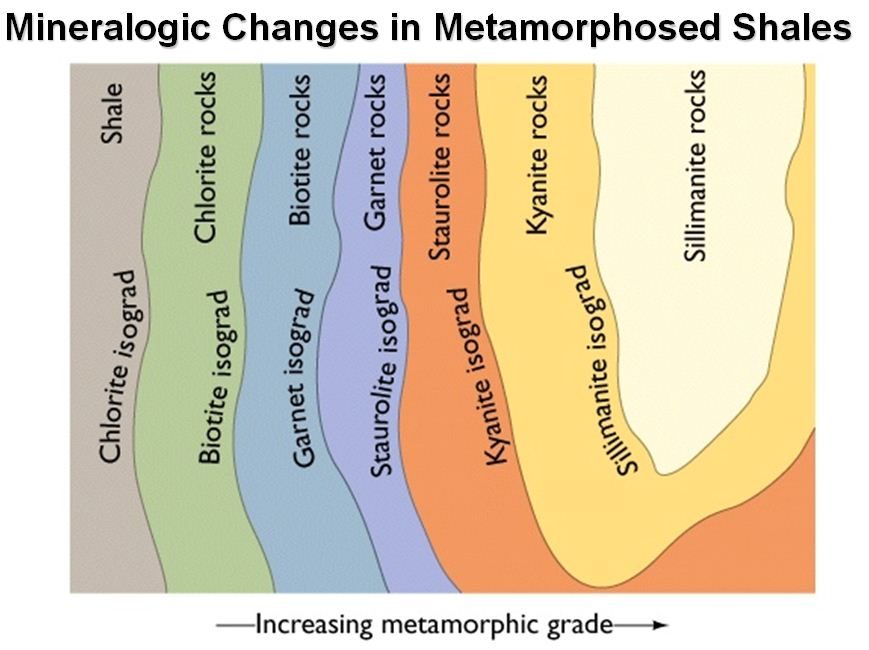
1.3.3 Barrovian Metamorphic Zones
- Chlorite zone – lowest grade metamorphism.
- Biotite zone – increasing temperature conditions.
- Garnet zone – medium-grade metamorphism.
- Staurolite zone – higher temperatures and pressures.
- Kyanite zone – high-pressure metamorphism.
- Sillimanite zone – highest-grade regional metamorphism.
These zones indicate increasing metamorphic intensity from low-grade to high-grade conditions.
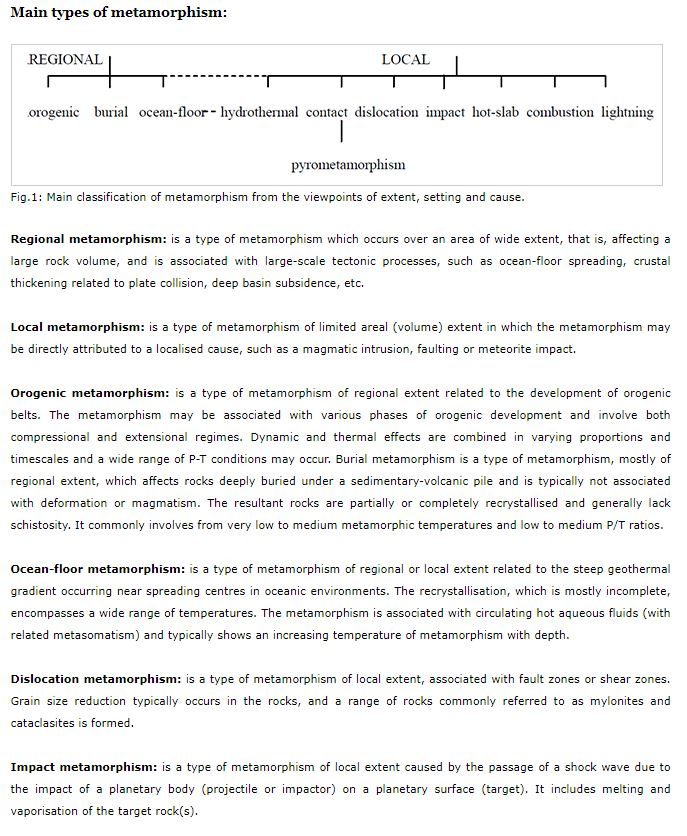
1.3.4 Types of Metamorphism
1.3.4.1 Regional metamorphism
- Occurs over large areas.
- Associated with mountain-building processes.
- Produces foliated rocks such as schist and gneiss.
1.3.4.2 Contact metamorphism
- Occurs near igneous intrusions.
- Dominated by heat rather than pressure.
- Produces hornfels, marble, and quartzite.
1.3.4.3 Hydrothermal metamorphism
- Involves hot, chemically active fluids.
- Common near volcanic and mid-ocean ridge environments.
- Produces rocks such as serpentinite.
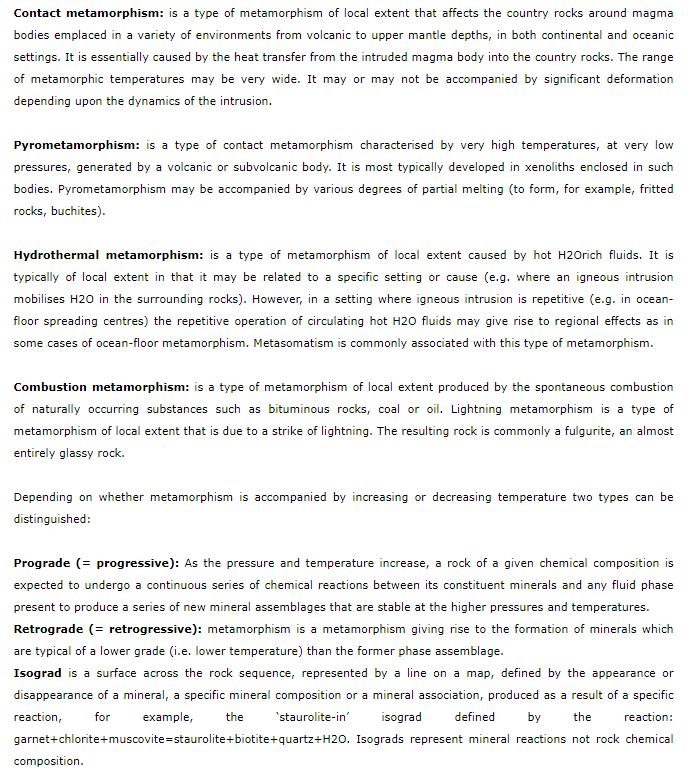
The following is a more detailed description on this:
The following diagrams give an idea:
1.4 Rock Cycle
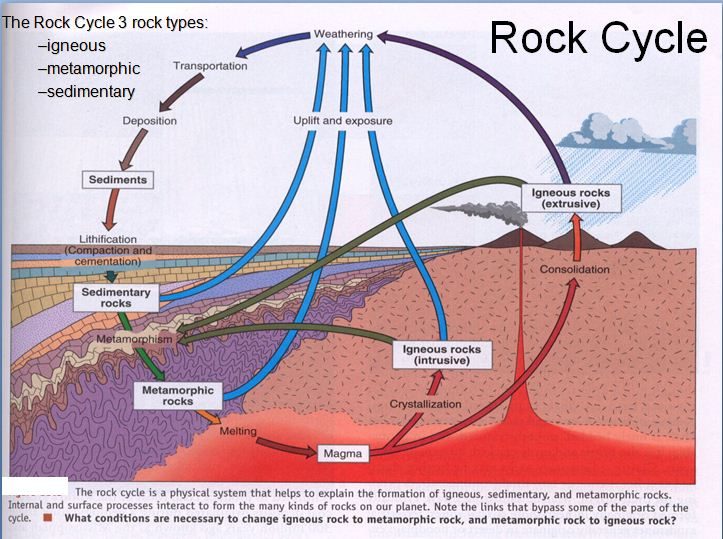
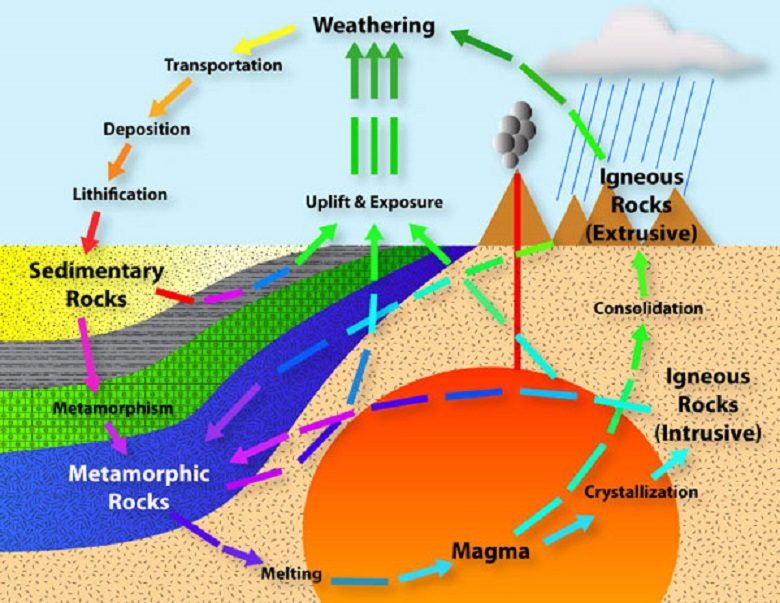
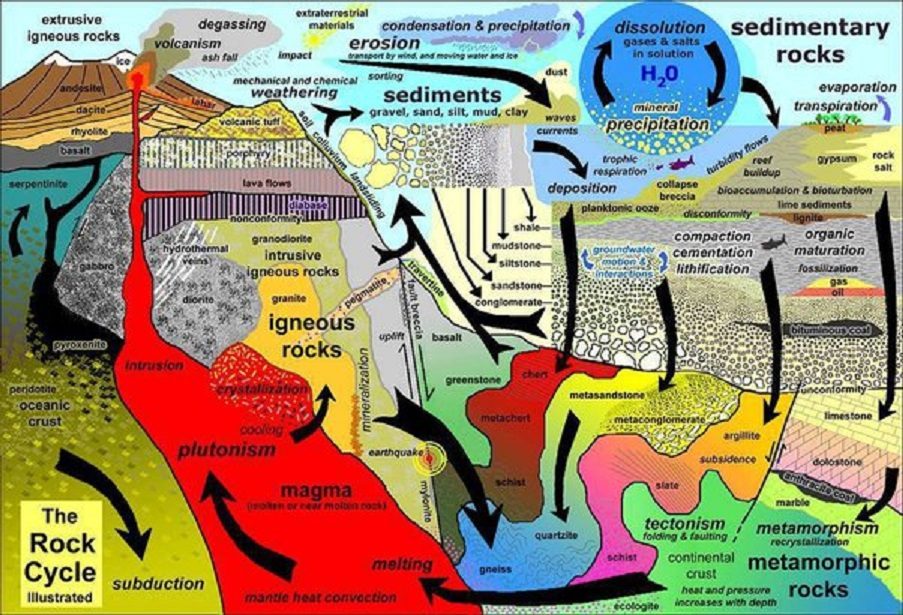
It is probably now appropriate to look at the rock cycle, to see how these all fit together:
2. Rock Classification
Rock classification is fundamental and extremely important, as this will identify and give a name to a rock, based on systematic principles. If you do not have and understand this knowledge, your rock identification will be blind, with no proper reasoning behind it, basically guesswork based on a little, but grossly insufficient, knowledge. Do not rely primarily on AI to deliver a correct identification.
Having understood the three rock groups, igneous, metamorphic and sedimentary, rocks are essentially classified on their mineralogy, texture, and lithological environment
2.1 Igneous Rock Classification
Igneous rocks are classified based on them being composed of three essential minerals (any other minerals that occur are accessory minerals), and are classified on ternary and chemical plots/diagrams. You will recall that igneous rocks are essentially divided into plutonic/intrusive rocks, and volcanic/extrusive rocks. Their chemistry ranges from ultramafic (ultrabasic), mafic (basic), intermediate, to felsic (acid). Rock acidity and alkalinity has nothing to do with pH, it is a measure of silica (SiO2) content.
2.1.1 Felsic and Intermediate Rock Classification
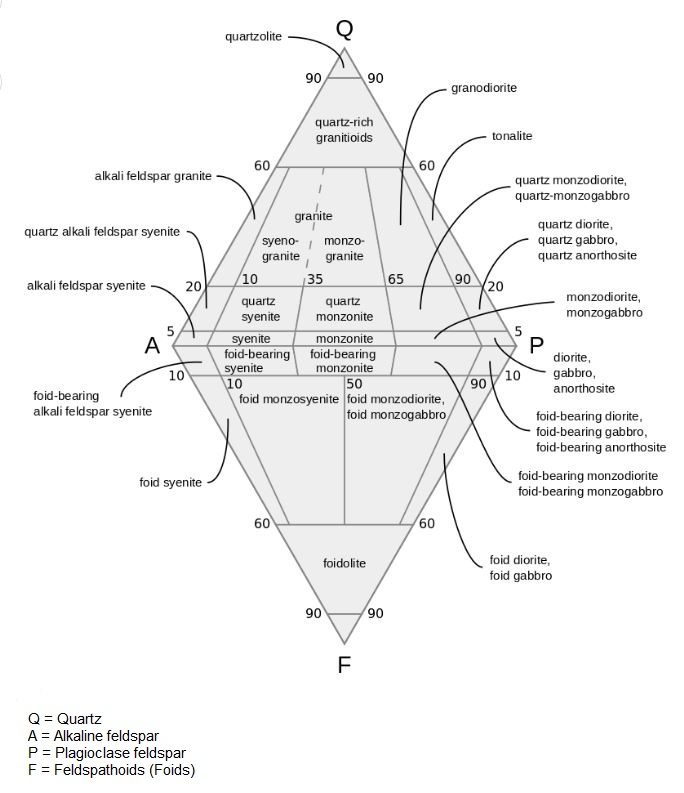
The fundamentals of this are based on the following plutonic and volcanic ternary diagrams:
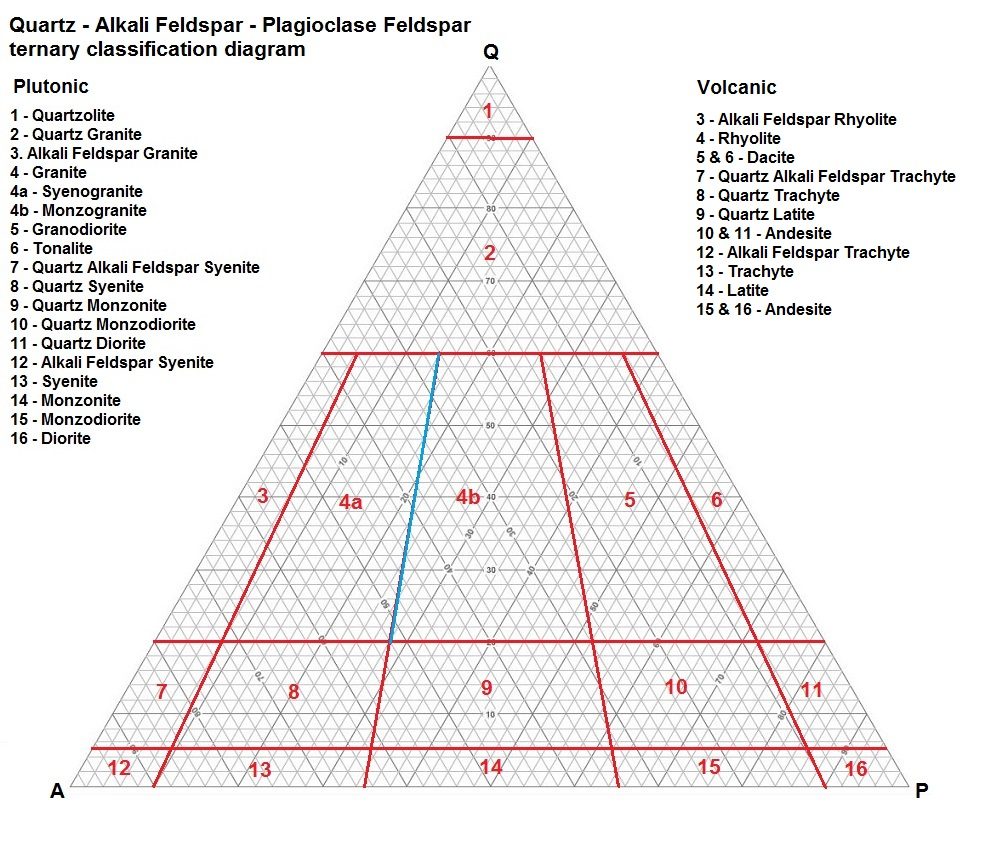
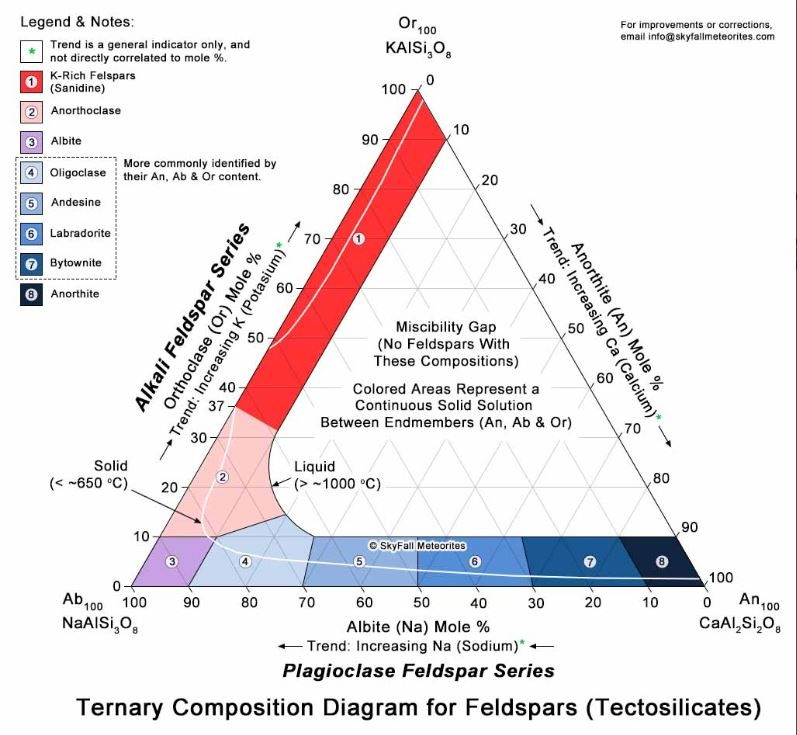
This Quartz-Alkali Feldspar-Plagioclase Feldspar (Q-A-P) ternary diagram classifies felsic plutonic and volcanic rocks. The plagioclase feldspar is albite (Na rich plgioclase - see Bowen's Reaction Series later). The fields adjoining the A-P line are intermediate rocks.
The outside line joining Q (quartz) and A (alkali feldspar) is the line of 0% P (plagioclase feldspar). An increase in P content is at right angles to the line towards the P apex. The P apex is the point of 100% plagioclase.
The outside line joining A and P is the line of 0% Q. An increase in Q is at right angles to this line towards the Q apex. The Q apex is the point of 100% Q.
Likewise, the outside line joining P and Q is the line of 0% A. An increase in A content is at right angles to this line moving towards the A apex. The A apex is the point of 100% A.
The plot is divided into a number of fields that determine the rock type, with specific percentage boundaries of each of the three minerals. Having determined the percentage of Q, A and P in a rock (the total must add up to 100%) the rock in question will plot as a point somewhere on the diagram, and hence providing the identification.
For example, a rock consisting of 40% Q, 45% A, and 15% P will plot as a point in field 4a, being granite, and more specifically, syenogranite, a felsic plutonic rock.
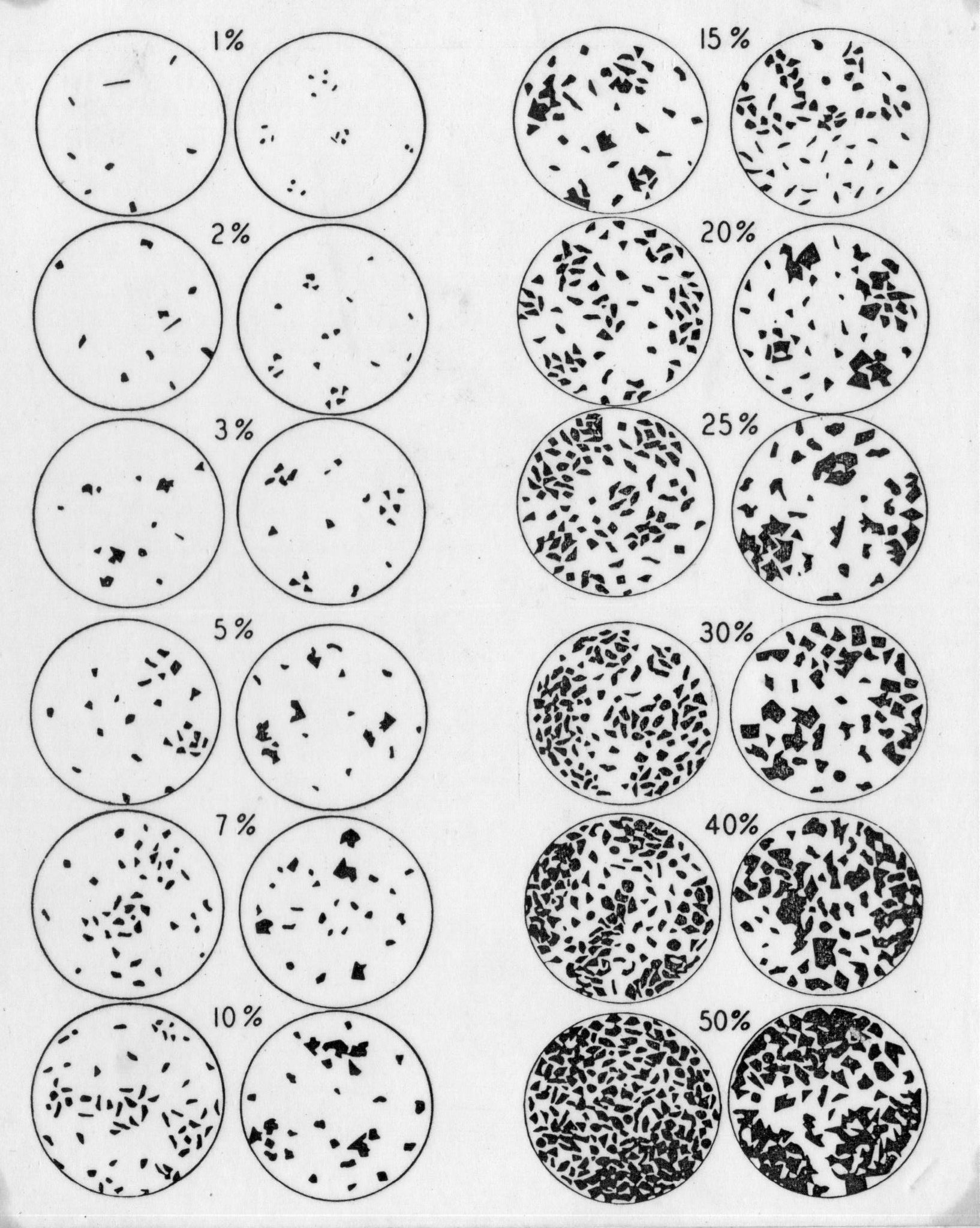
To help with determining the percentages of each mineral, the following diagram is useful.
Now, we take a look at the F-A-P diagrams, which fit on the bottom of the Q-A-P diagram, and classify intermediate feldspathoid bearing plutonic and volcanic rocks. Using them is exactly the same as for the Q-A-P diagram, as is the case with all ternary diagrams.
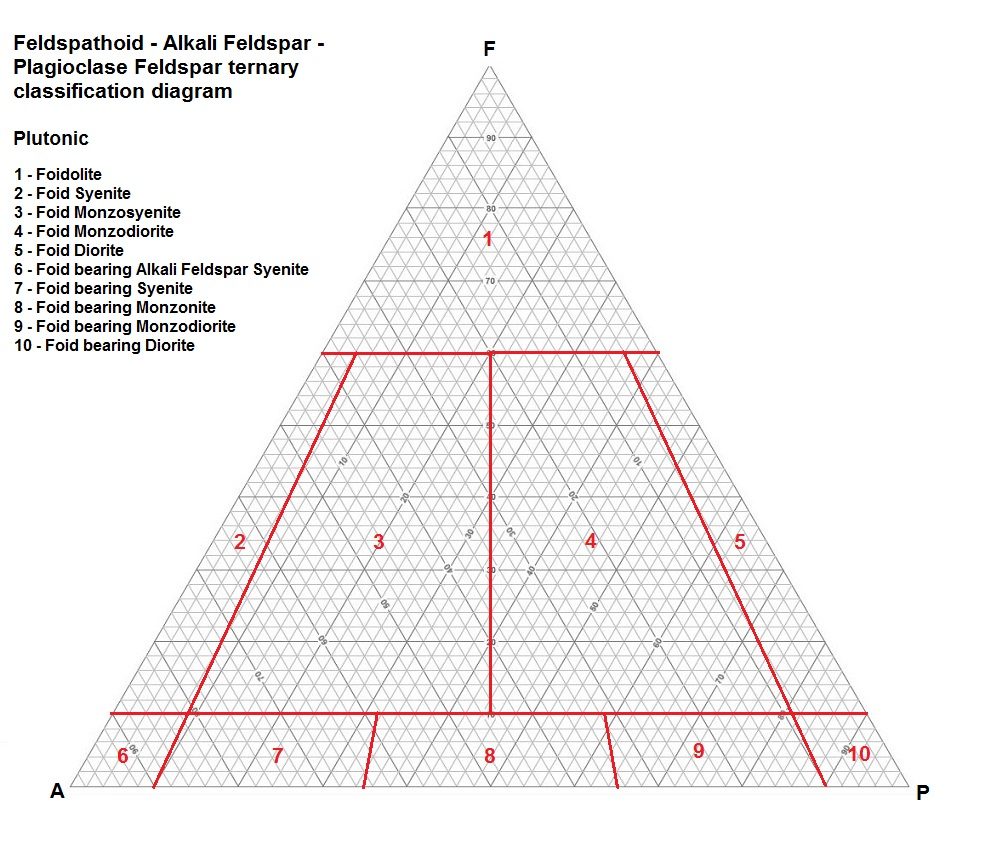
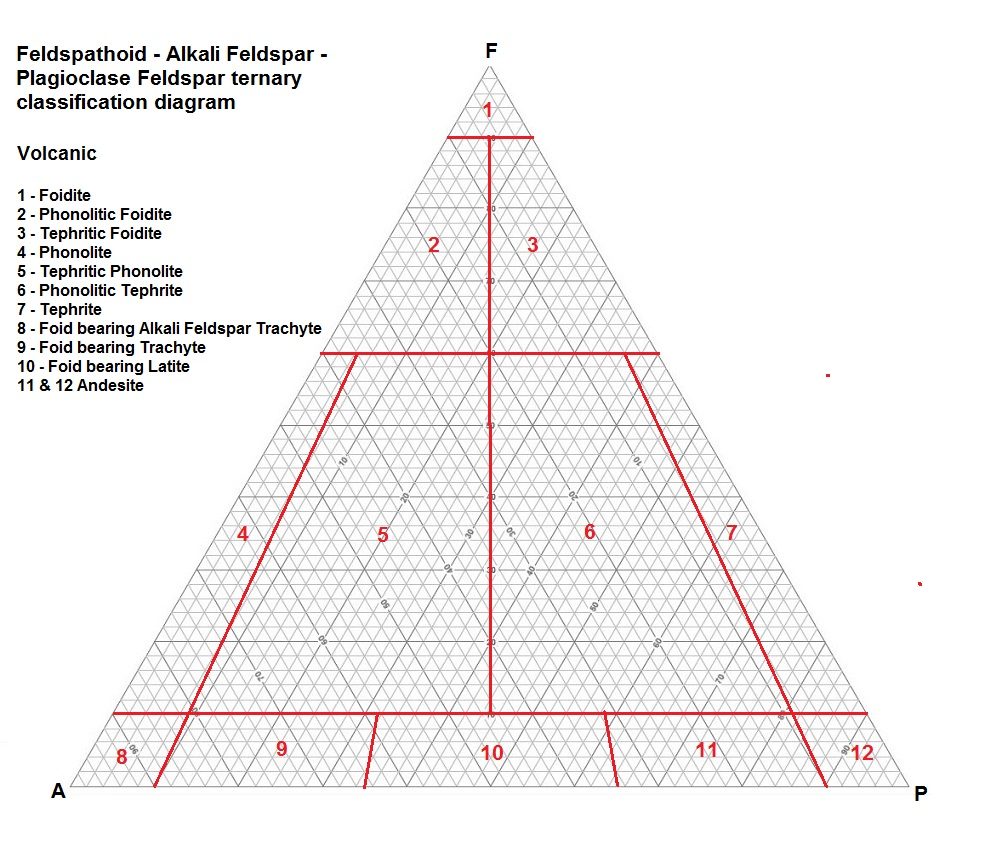
Here is how the Q-A-P and F-A-P diagrams relate to each other, now known as the Q-A-P-F diagram. (plutonic in this case).
2.1.2 Ultramafic and Mafic Rock Classification
This is also based on the ternary system with three essential minerals in each case (any other minerals that occur are accessory minerals).
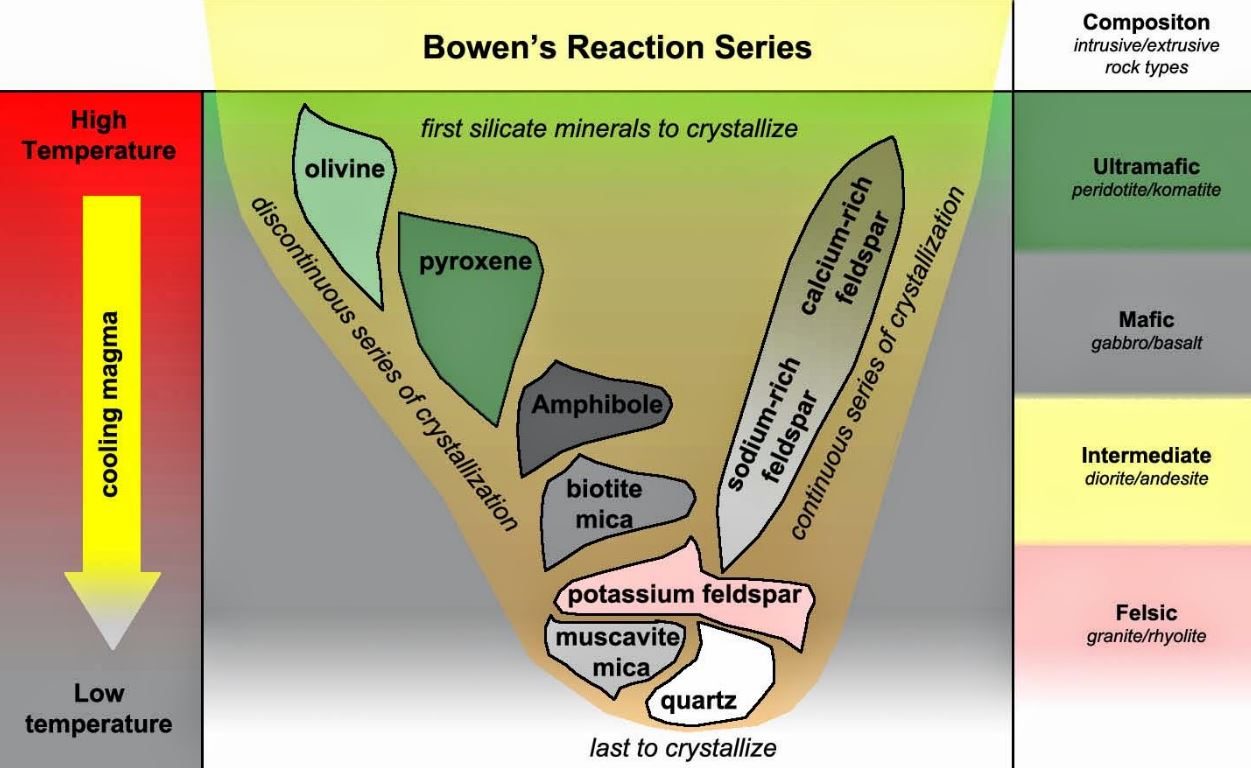
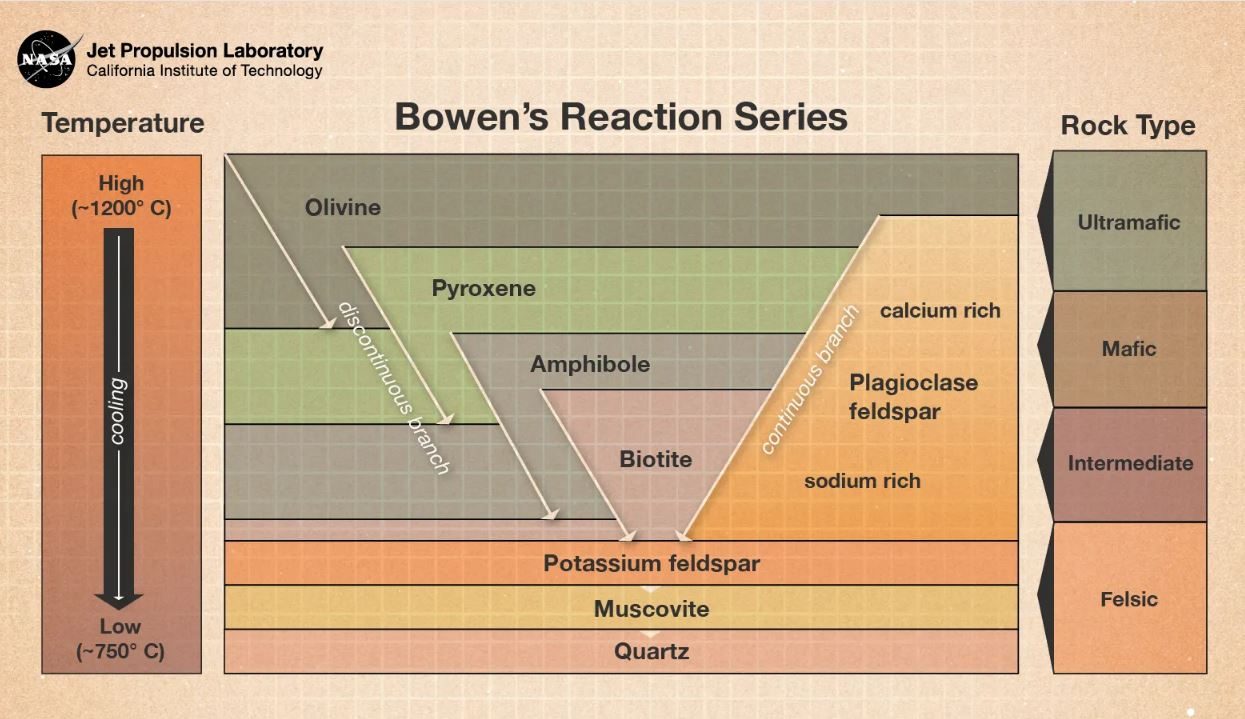
Firstly it is appropriate to look at the Bowen's Reaction Series diagram to understand the order in which rocks and minerals crystallize.
... and also the feldspar Or-Ab-An ternary diagram
The IUGS uses the following ternary diagram, composed of four adjoining ternary diagrams, to classify ultramafic and mafic plutonic rocks.
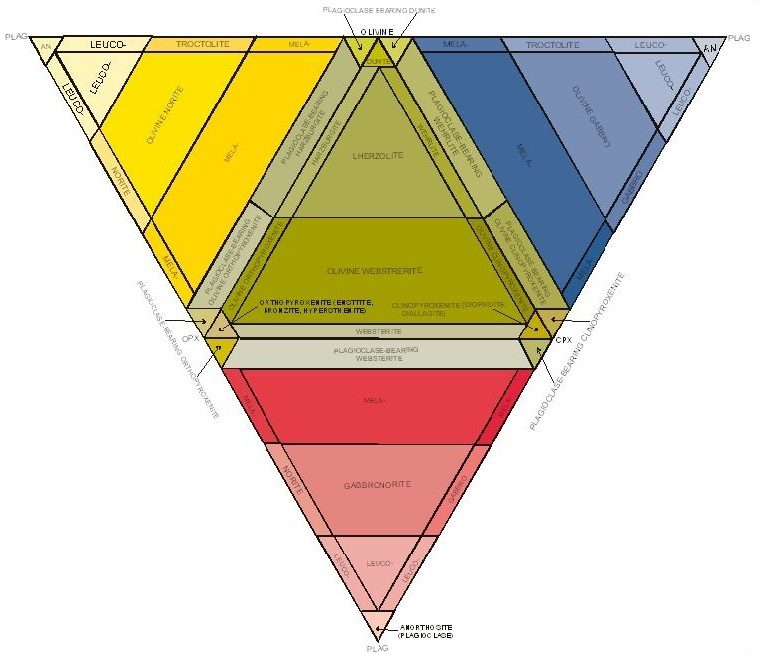
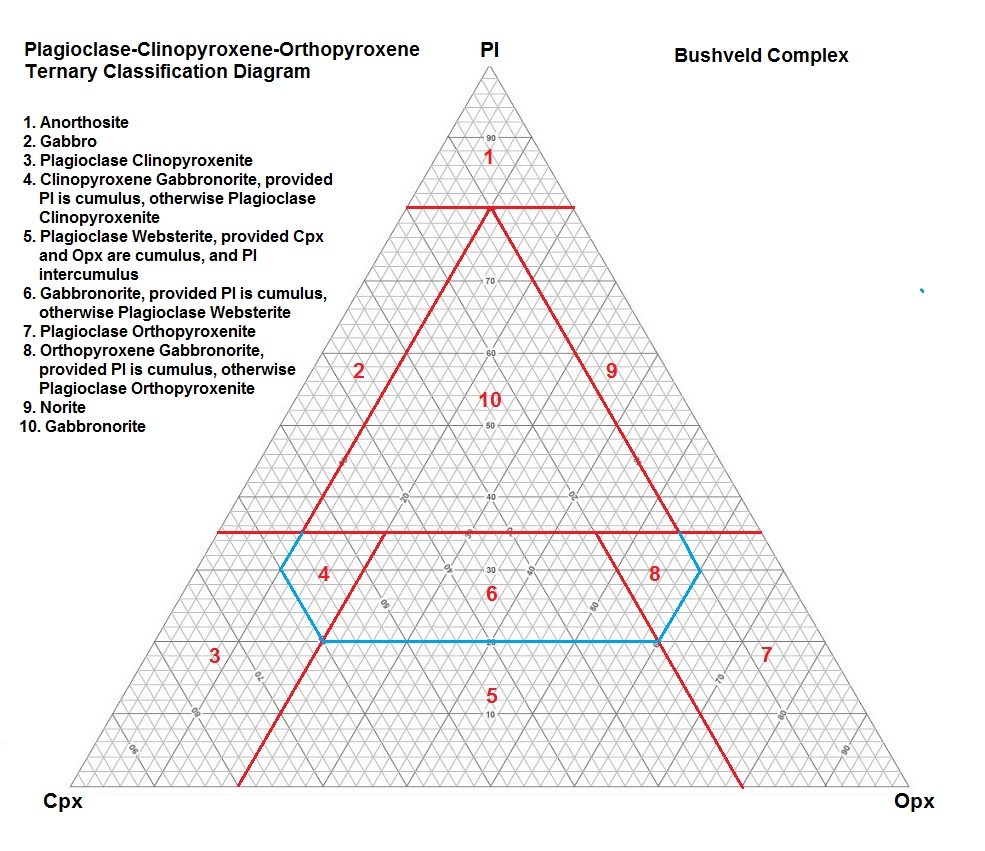
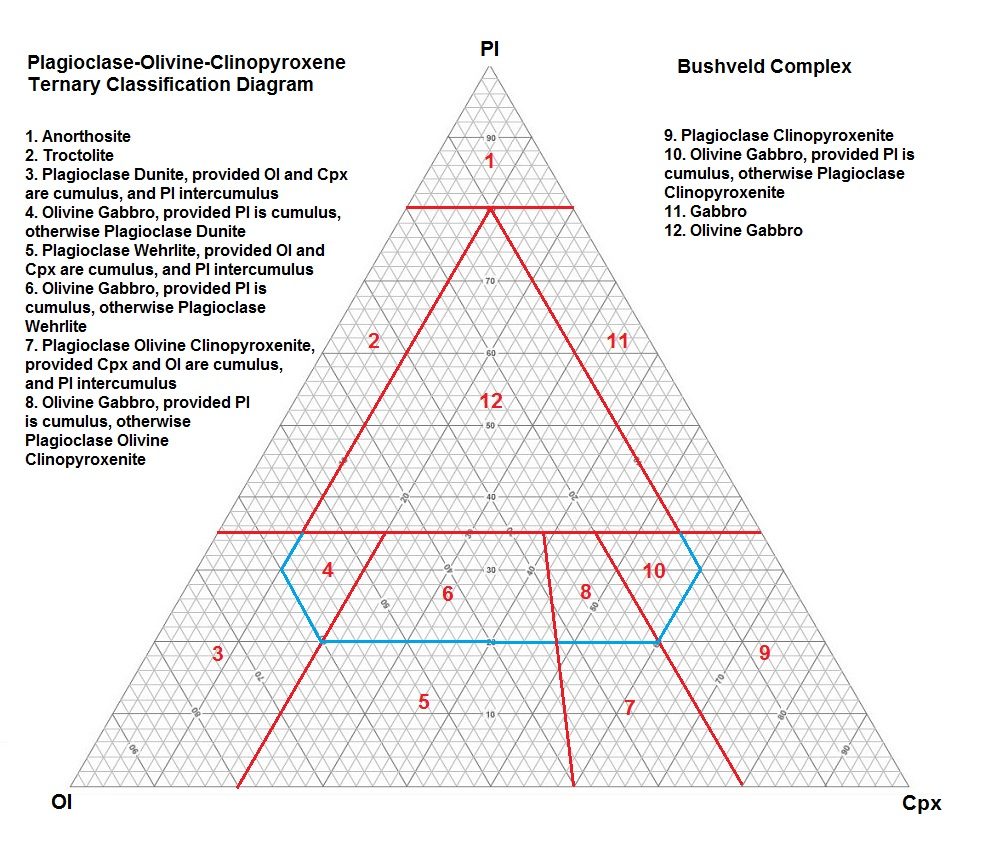
Since some of these fields are either too small, too slender, or too big, the following proposed ternaries suit data far better, and correctly classify these rocks based on mineral modal data, especially in the case of the two by far largest mafic-ultramafic complexes in the world, the Bushveld Complex and the Great Dyke. Firstly, a similar four module ternary Plagioclase-Olivine-Orthopyroxene-Clinopyroxene (Pl-Ol-Opx-Cpx) is presented, followed by the individual ternaries. They are used and read exactly as described for the Q-A-P ternary earlier.
The plagioclase here is Ca rich anorthite, as shown on the Bowen's Reaction Series diagrams.
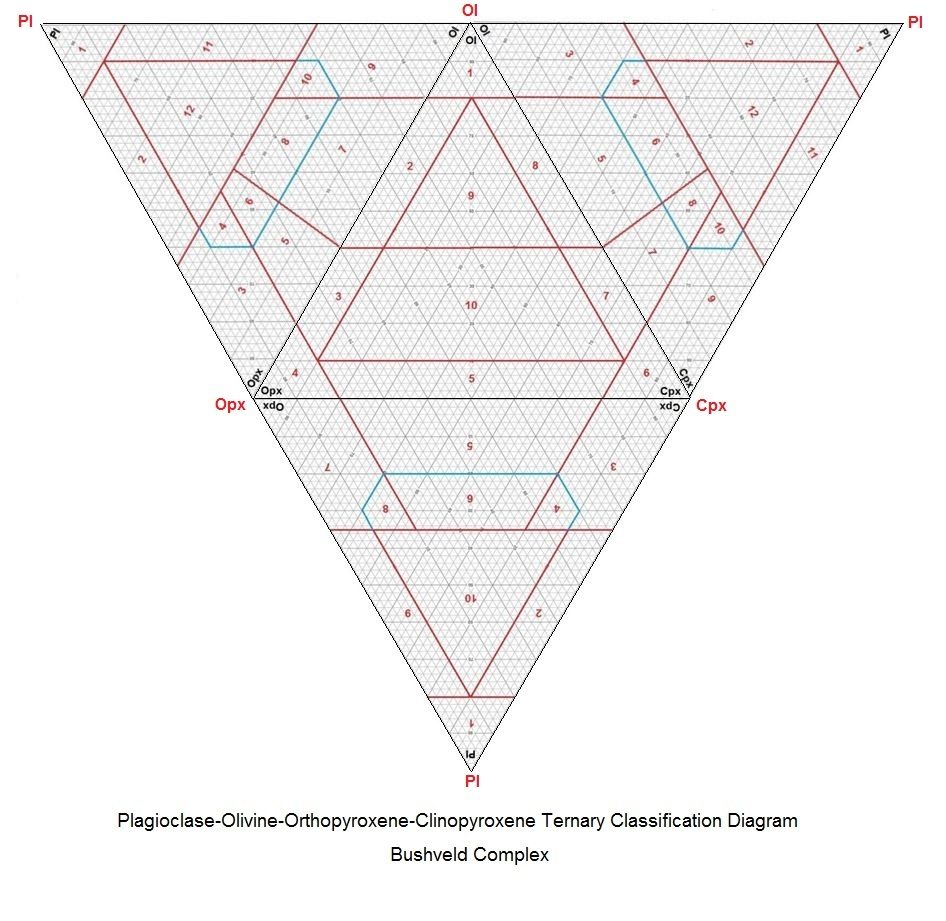
The four individual ternaries follow, three of which have plagioclase as a component. There are many more where plagioclase either is, or is not, one the three essential minerals, ie where magnetite (Mt) or chromite (Cr) are one of the essential minerals.
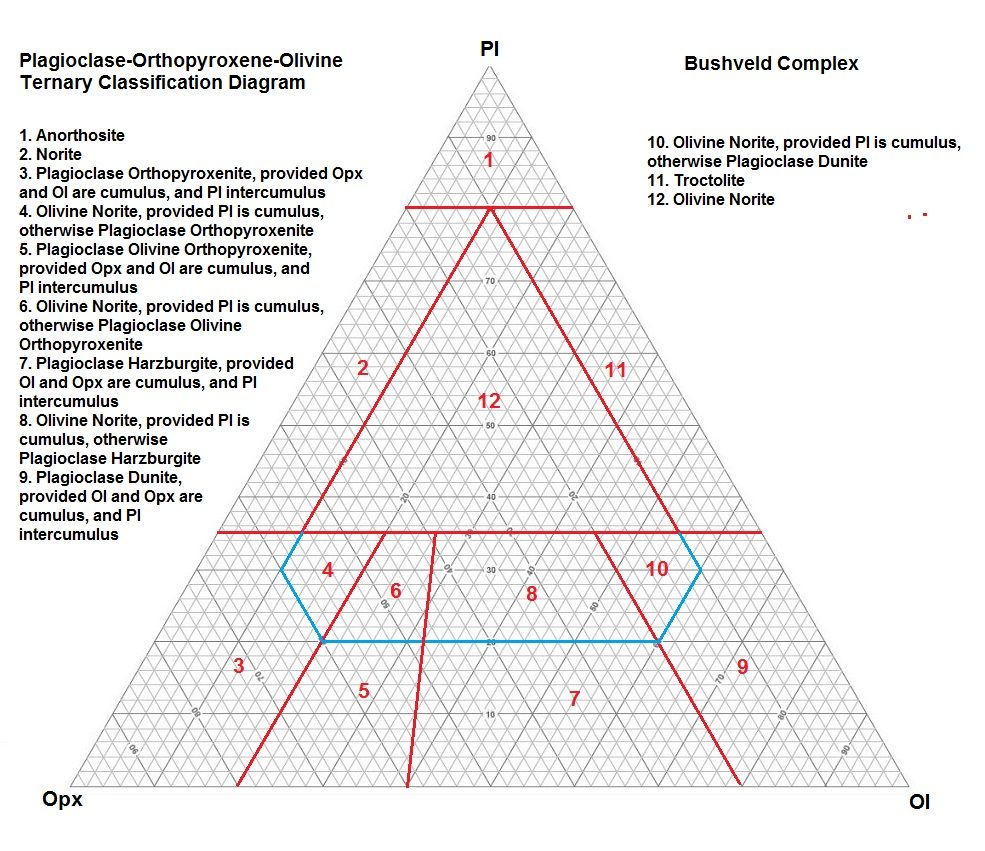
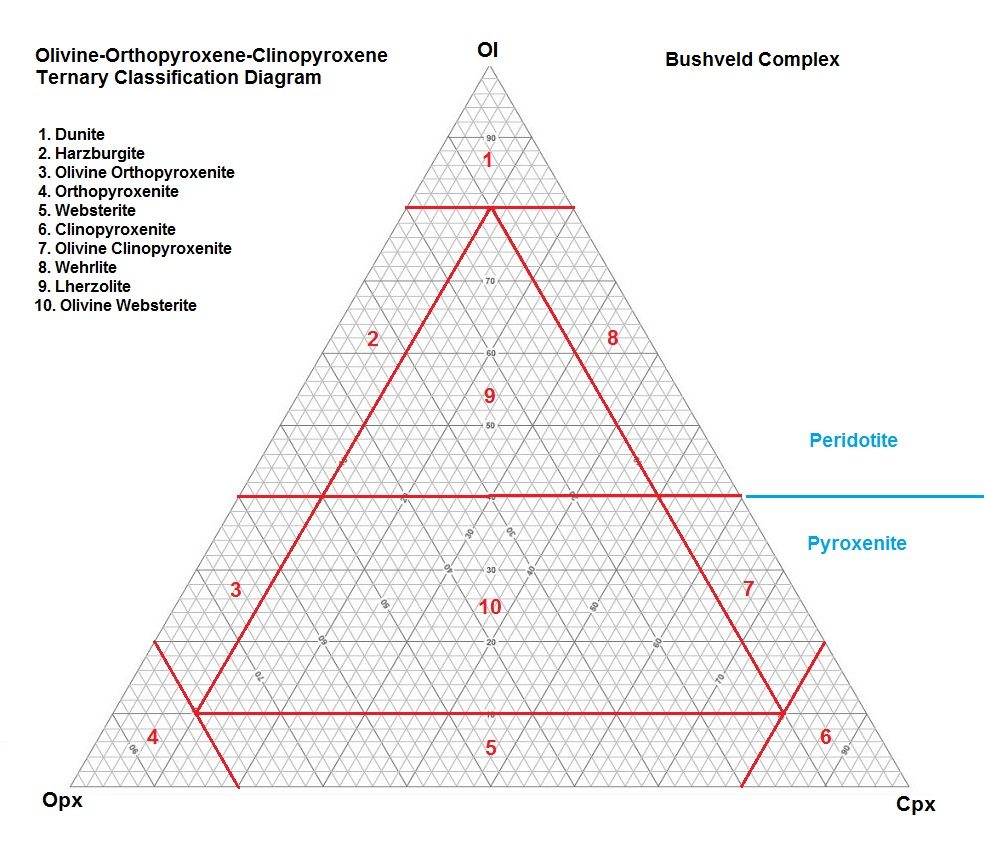
2.1.3 Volcanic Rock Classification
Since volcanic rocks are so fine grained, it is difficult to see the mineralogy without the use of thin sections and petrographic microscope (petrography). The alternative is to classify them from chemical analysis, ie chemical classification. The following diagrams give examples of how this is done.
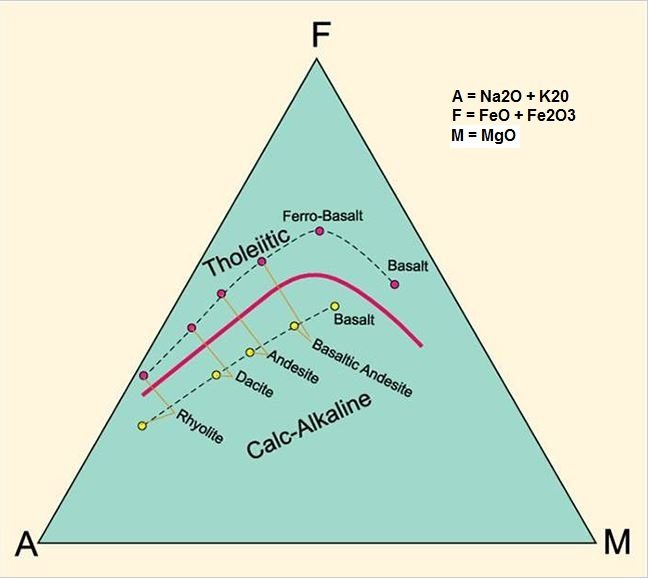
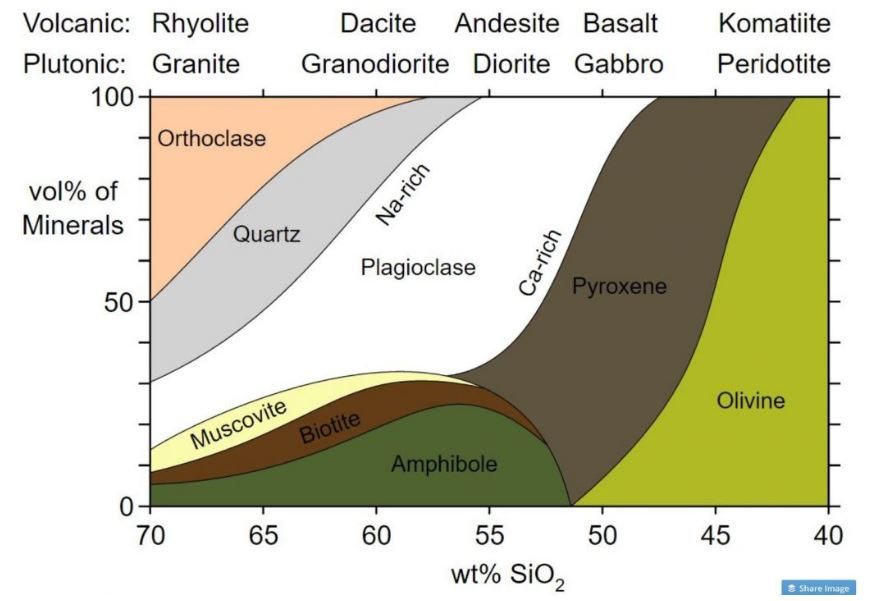
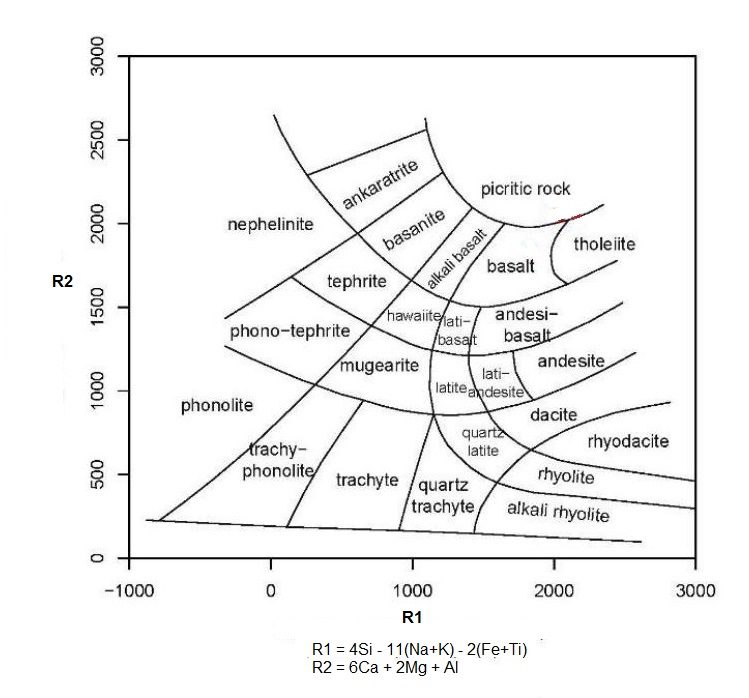
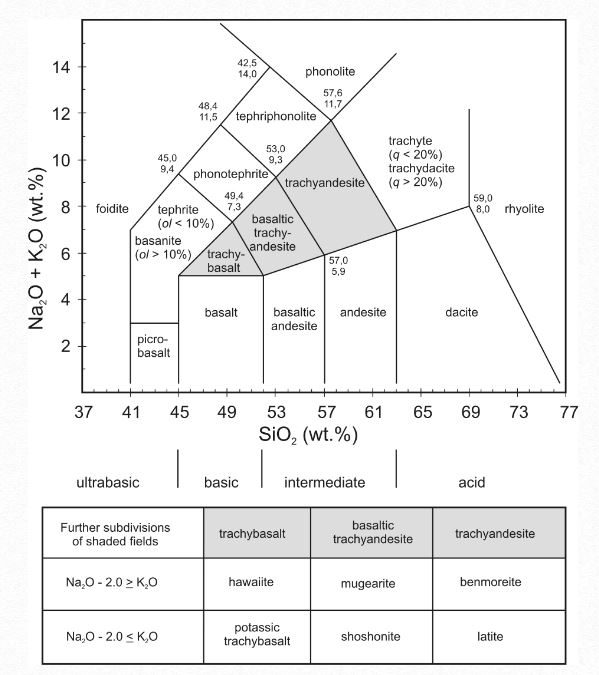
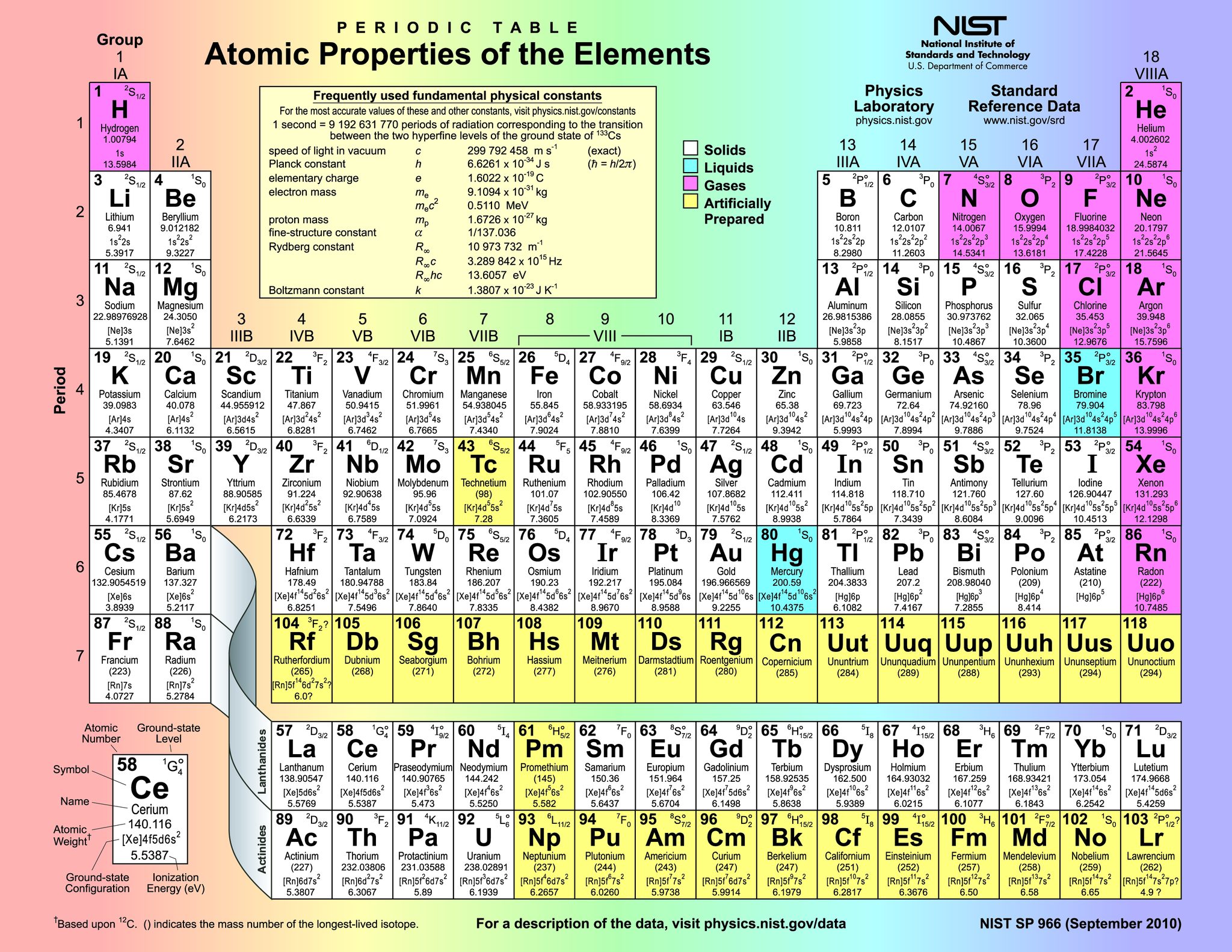
A periodic table is useful to see and understand all the elements and their properties.
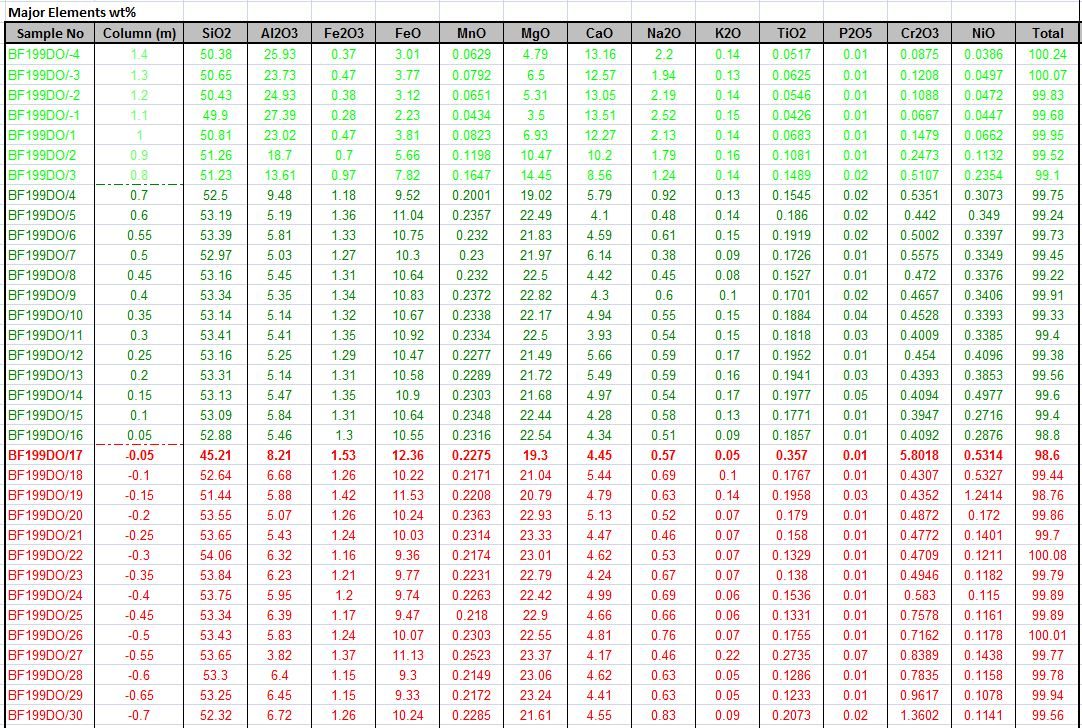
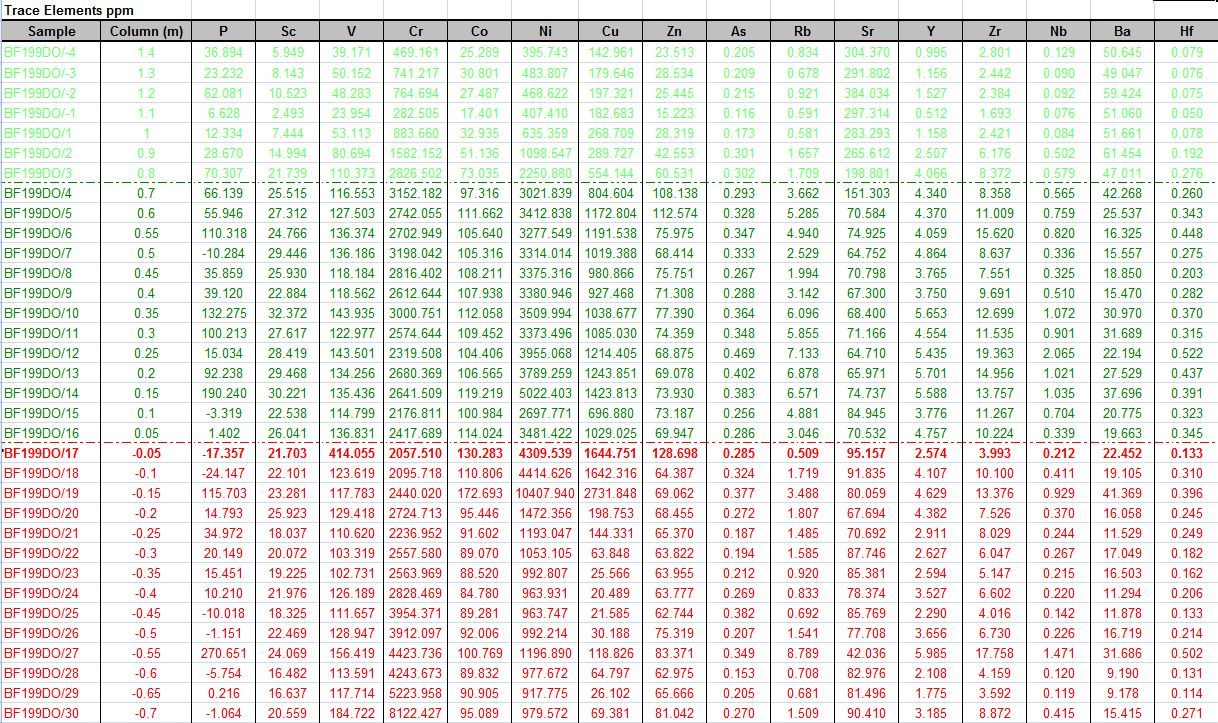
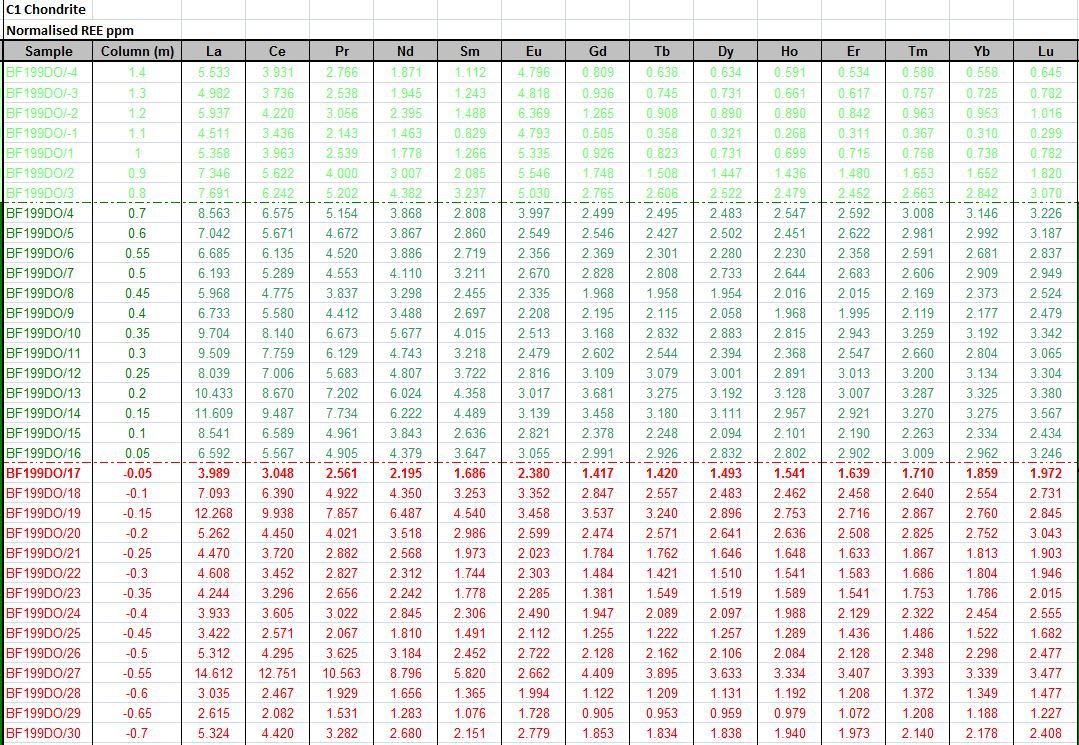
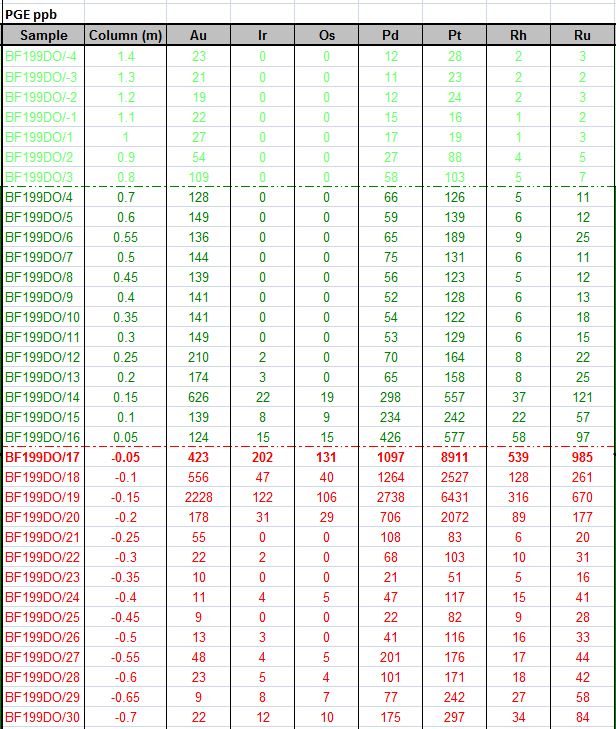
Here is an example of a rock chemical analysis (only a small portion of it in this case), from the eastern Bushveld Complex Merensky Unit.
2.1.4 How To Recognize and Classify Rocks
If you are not that familiar with geology, rocks, and lithological environments, take the following steps:
a) Read and understand this blog post, and use the internet, so you are a little better prepared.
b) Obtain, and locate yourself on a geological map of the area, then look at the legend to see what the geological terrane and your rocks of interest have been mapped as. Geological maps of most countries and states are widely available on the internet.
c) Establish what rock group it is, igneous, metamorphic, or sedimentary.
d) Photograph the rock/mineral as it occurs naturally. Then, certainly in the case of rocks, break a piece off and photograph the fresh surface as many times as you wish. In both cases, take close up, in focus, and sufficiently illuminated photographs, so the texture and mineralogy can be properly seen. Use a scale bar if possible. Distant photographs, or a specimen taking up just a tiny fraction of a photograph, are of absolutely no use at all, and just a complete waste of everybody's time.
e) If you insist on photographing pebbles, which I generally do not recommend, at least break the pebble and take close up photographs of the fresh surface. Worn pebble surfaces largely obscure the texture and mineralogy of a specimen, which then makes confident identification either difficult or impossible.
f) Before you even post the observation, use all the information contained in this blog, and the internet if necessary, to guide you to a thoughtful conclusion. Name it as such in the title of your observation, and make useful field notes in the space provided. Then, and only then, ask AI to perform it's assessment, and then make informed selections.
g) If you are not sure of your identification, tag one of us and ask, and we'll do our best to assist, provided the photographs are of suitable quality.
h) This site is intended to become one of scientific interest and use. With that objective in mind, take your observations seriously, so that they may be of interest or use to someone else. What we do not need is a whole collection of incorrectly identified specimens, and poor photography of them.
i) iMineralogist is a young site, and will improve over time, but we need your help to make that happen.
2.2 Sedimentary Rock Classification
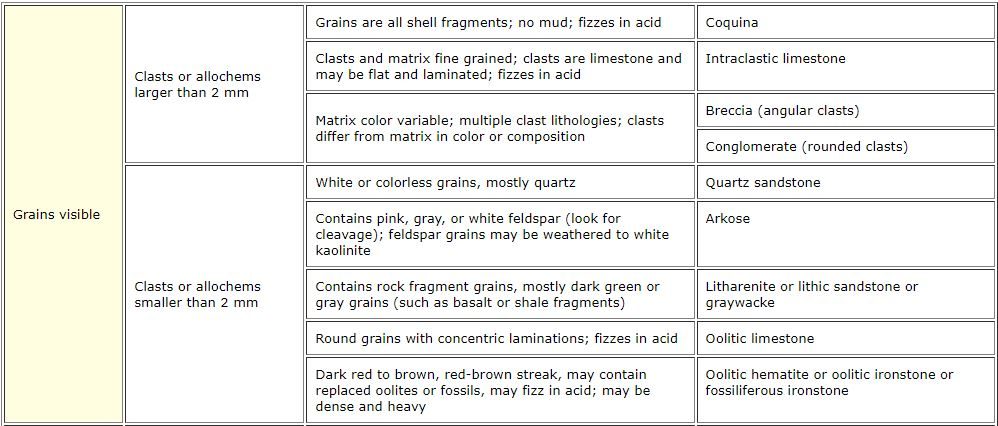
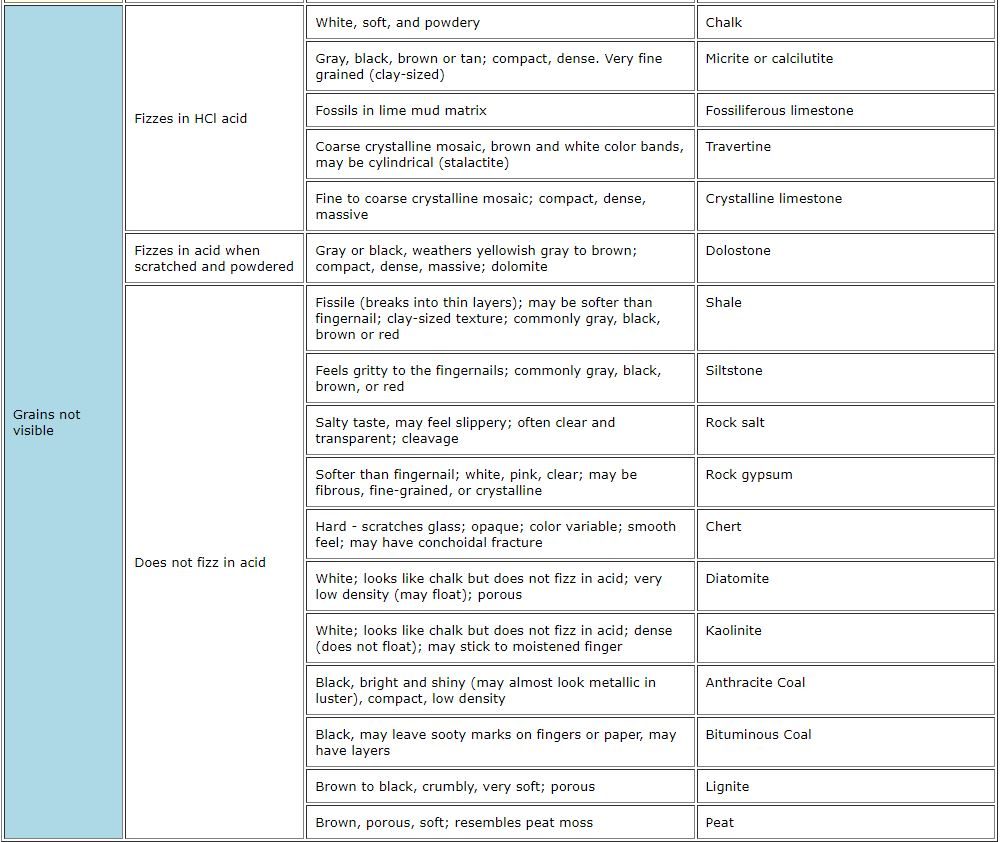
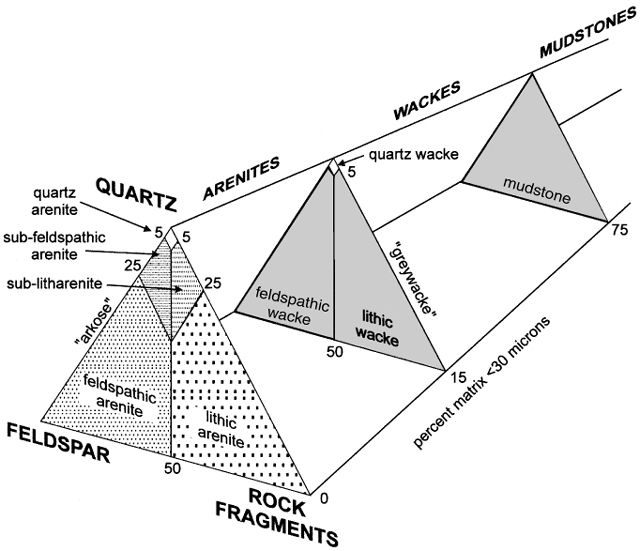
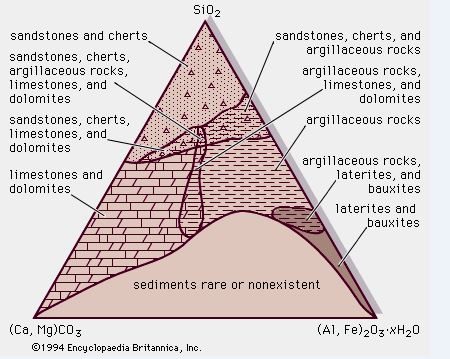
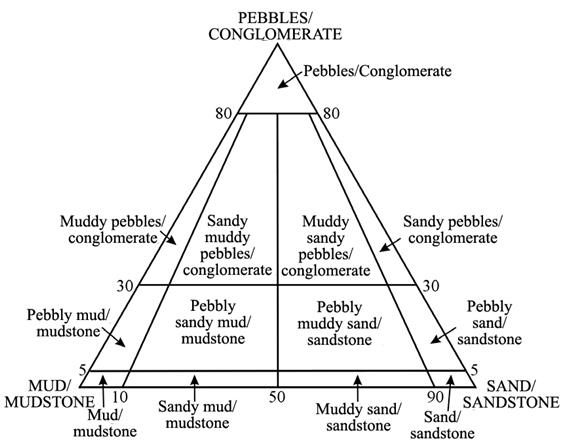
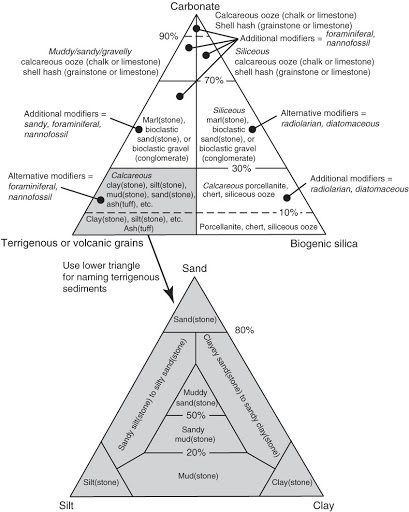
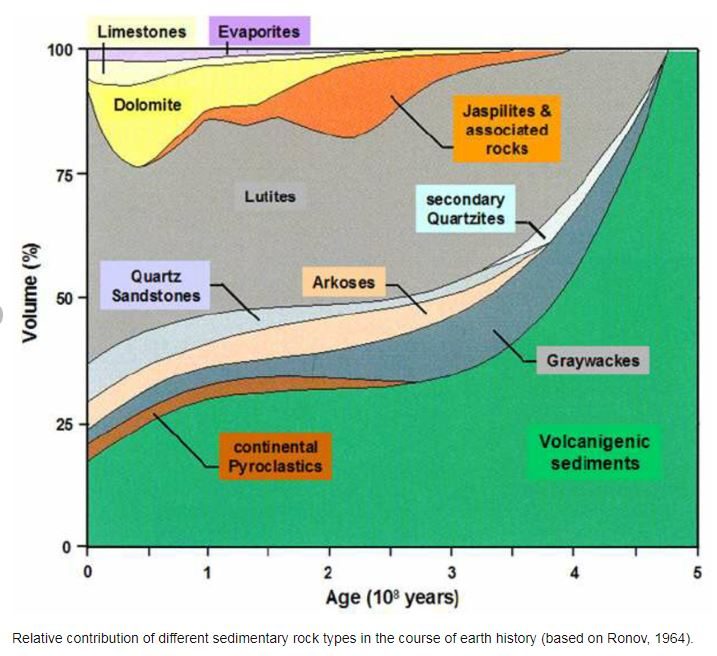
Apart from what was given earlier on sedimentary rocks, the following tables and ternary diagrams explain well the classification of sedimentary rocks.
2.3 Metamorphic Rock Classification
Adequate information on the classification of metamorphic rocks has already been given in section 1.3. There are two groups of metamorphic rock, meta-igneous, where the protolith is igneous rock, and metasedimentary, where the protolith is sedimentary rock. Metamorphic rocks are largely classified on texture and dominant minerals, or minerals that are formed from increasing metamorphic grade, especially the foliated metamorphic rocks, eg garnet gneiss, muscovite schist, etc.. The non-foliated have specific names, eg quartzite, marble, serpentinite, amphibolite, etc, based more on mineralogy and protolith.
Shale can go through various stages of metamorphism without necessarily altering to slate or phyllite, but can be hornfels. It is the indicator minerals that form through the metamorphic process that give a classification, eg chlorite shale. This diagram is shown earlier, but repeated here.
3. Earth Structure and Tectonics
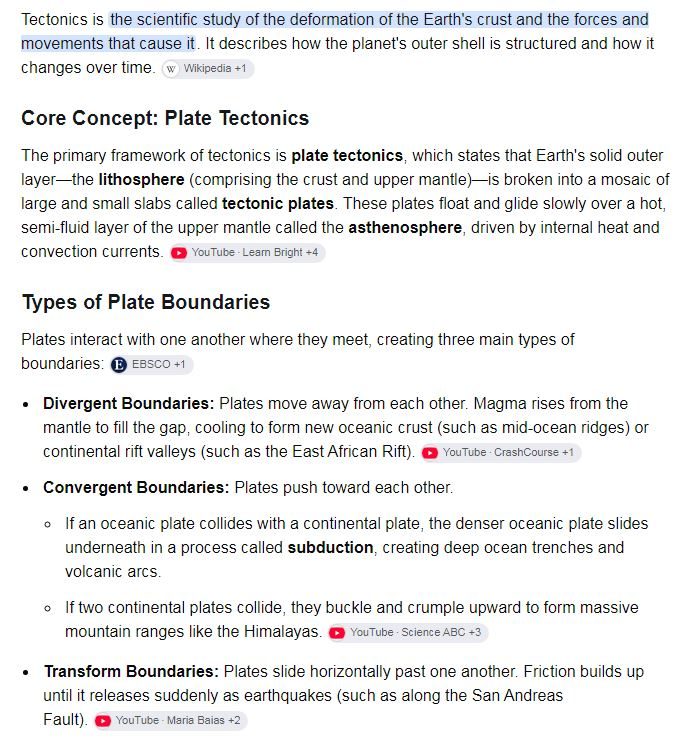
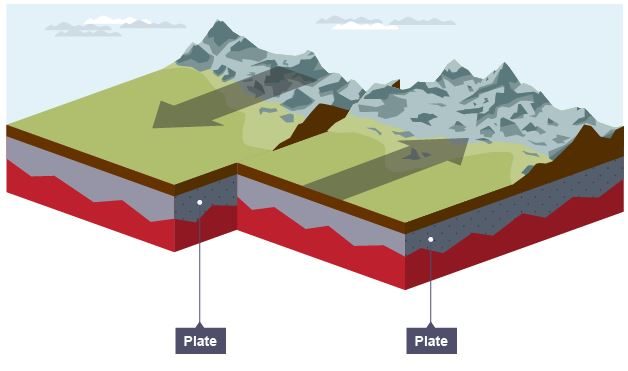
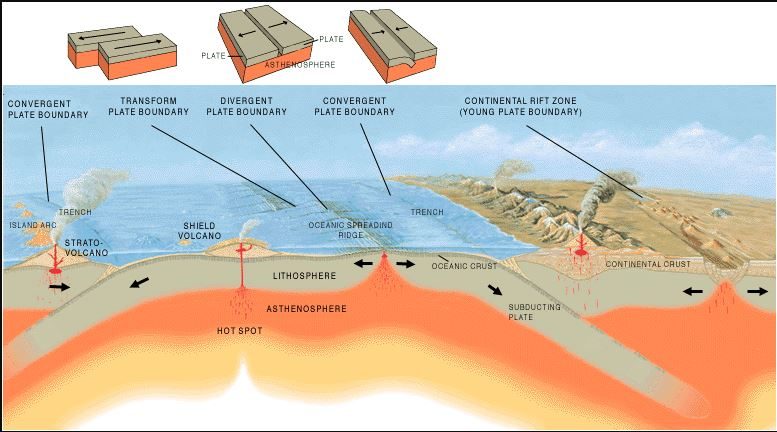
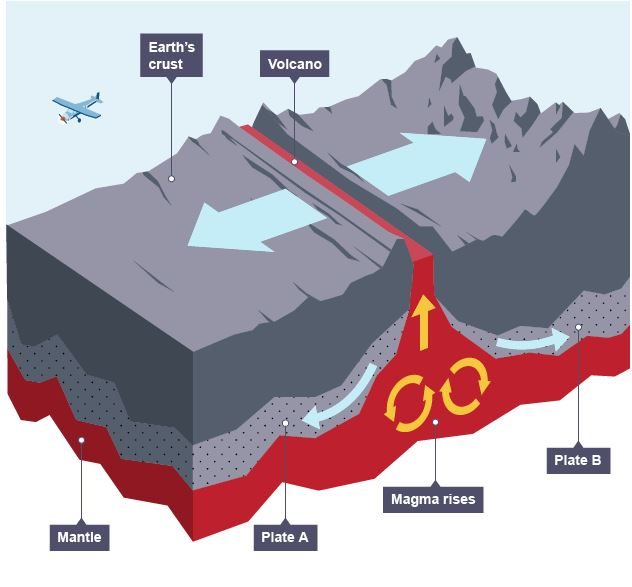
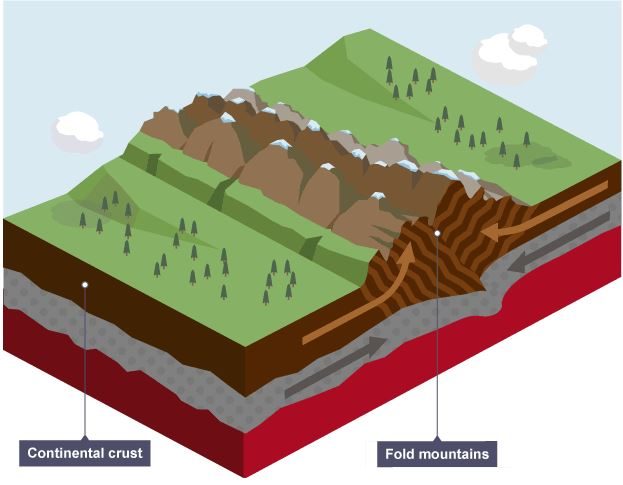
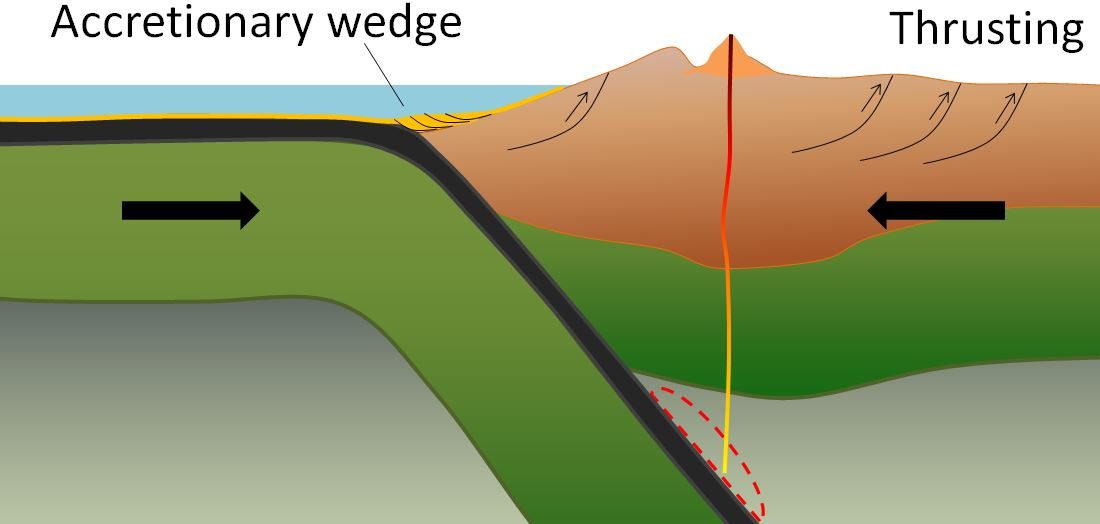
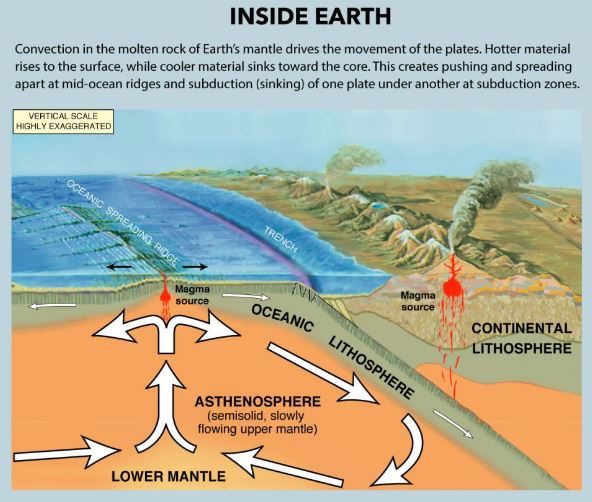
Tectonics are most powerful forces on Earth that drive a great deal of the way rocks behave and change.
For ease of getting the basic concepts across, I have taken the following Google AI description.
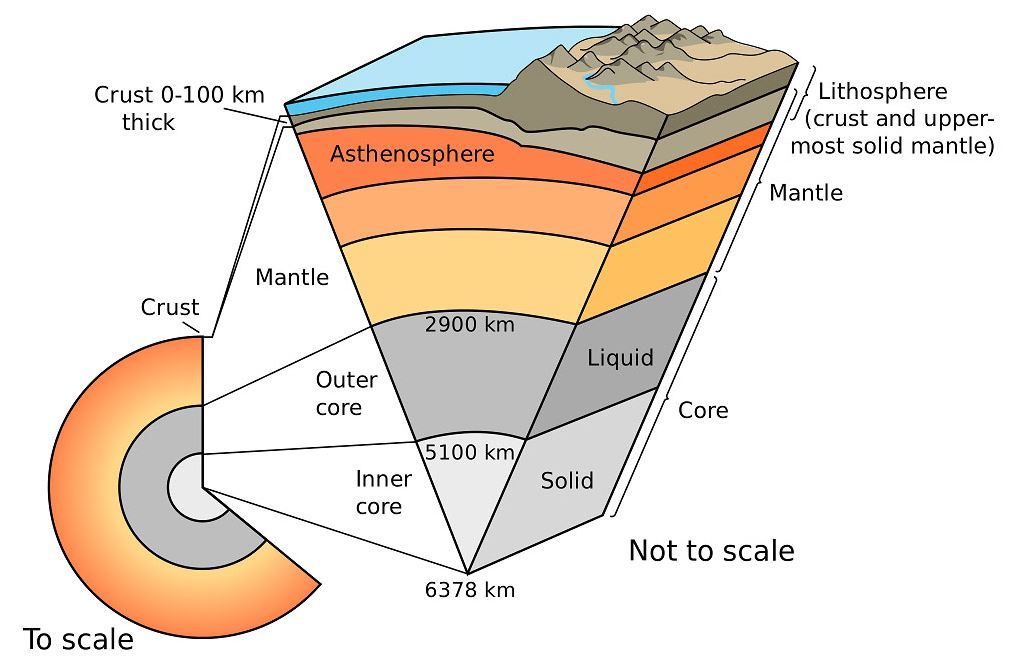
Earth structure:
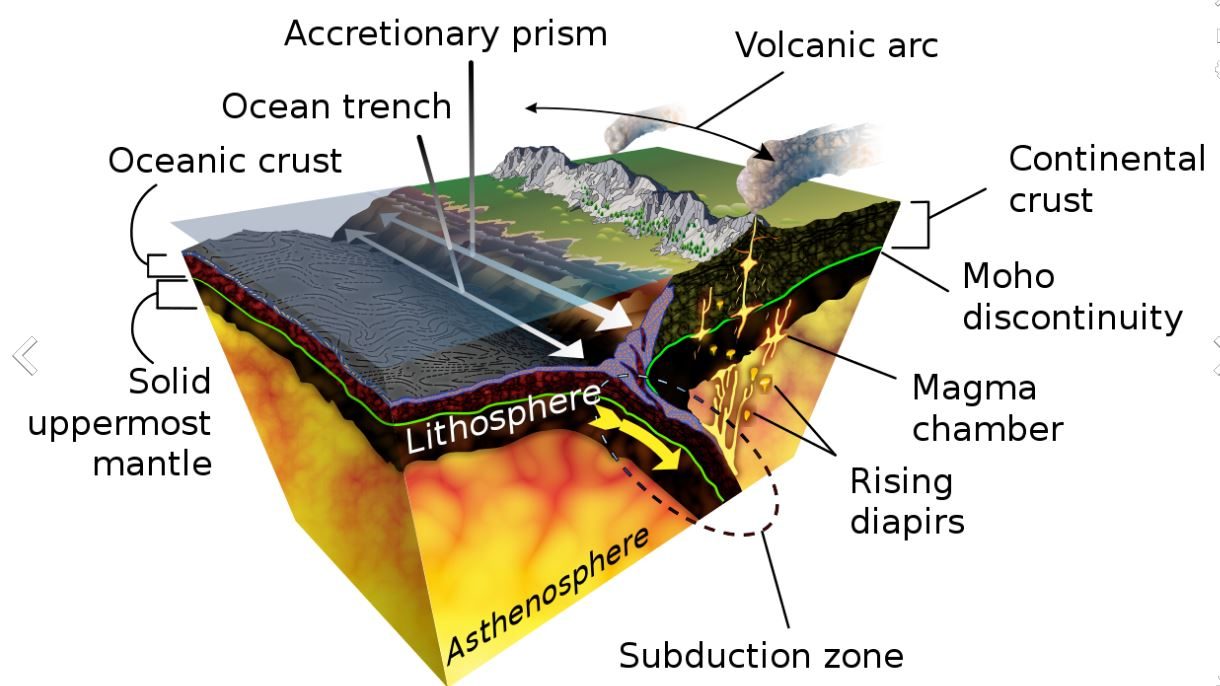
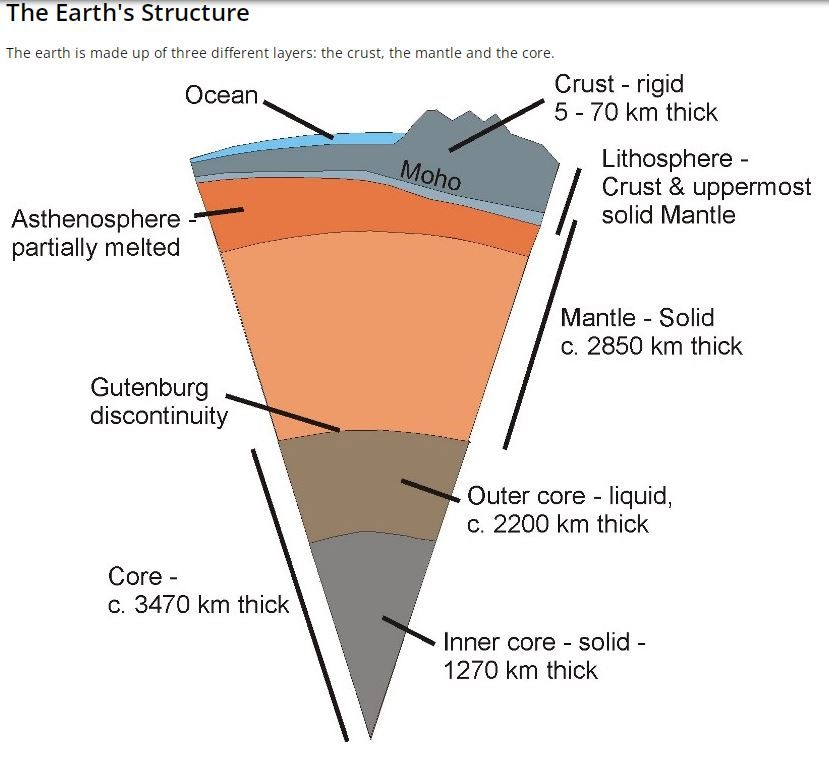
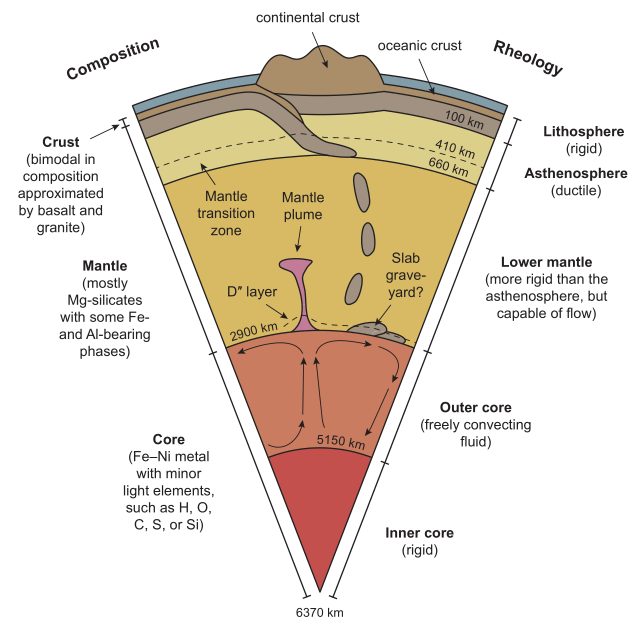
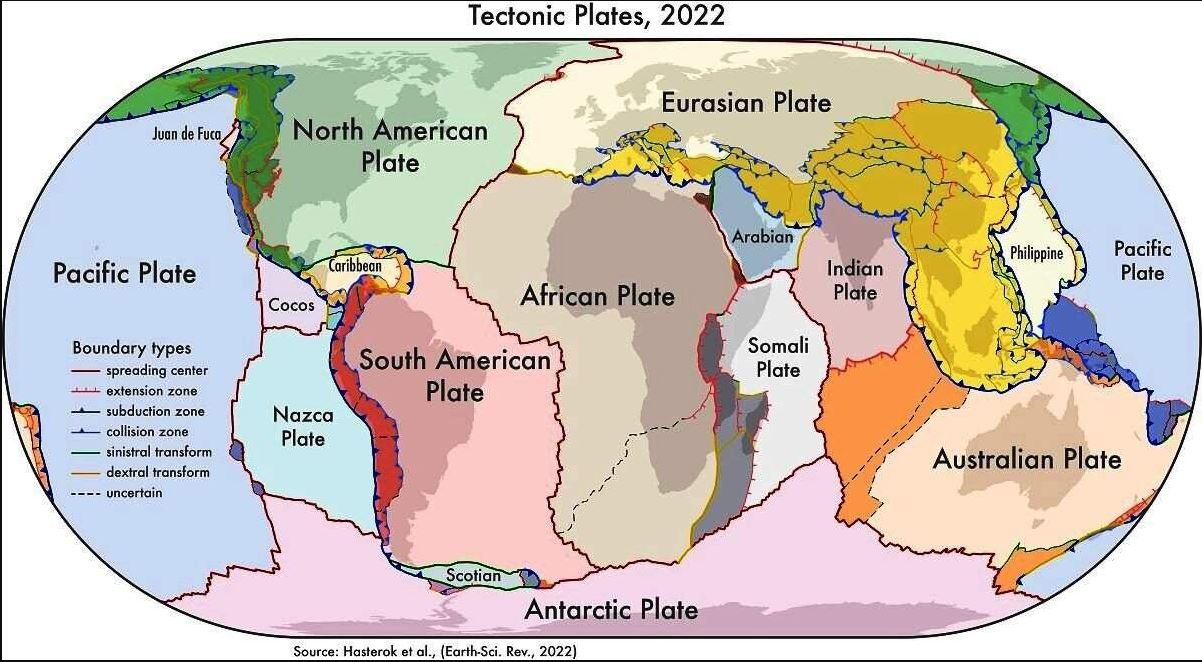
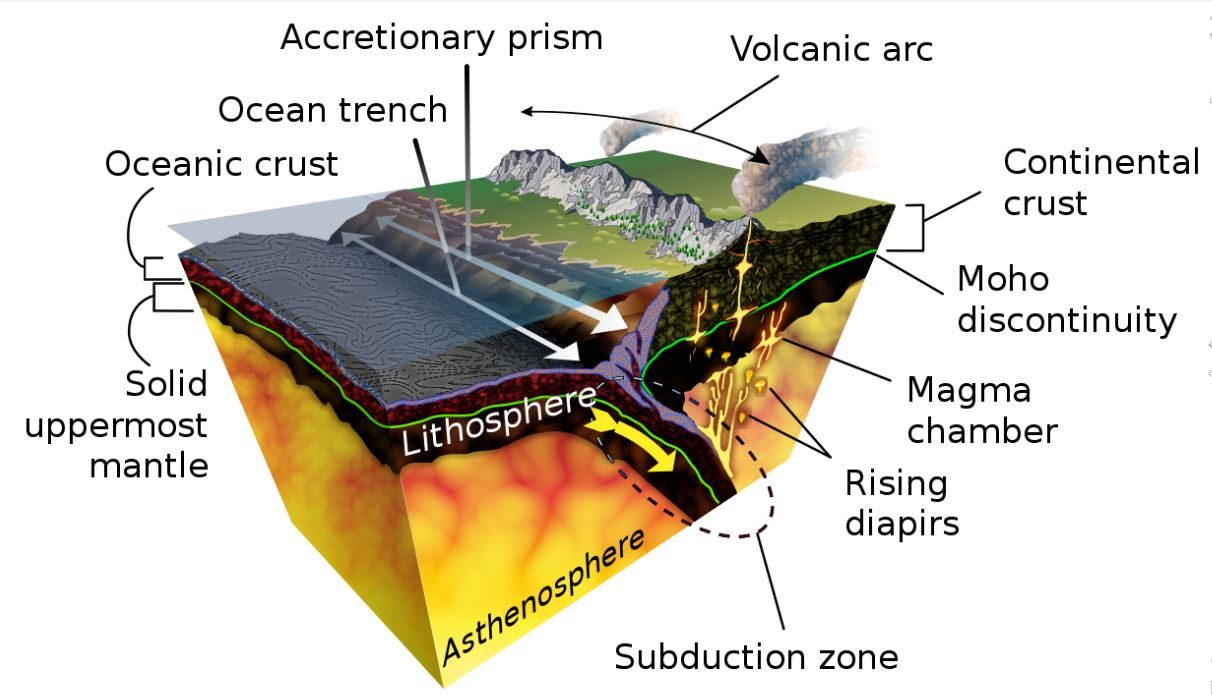
Tectonic plates:
Earthquakes and volcanoes typically occur along plate boundaries, and along major faults within the plates.
4. Alteration and Metasomatism
Both alteration and metasomatism result in changes to rock mineralogy and sometimes texture. Neither are classified as actual metamorphism. One of the main agents that cause these changes are hot hydrothermal fluid movement and circulation, which react chemically with the rock at various levels of intensity.
4.1 Alteration
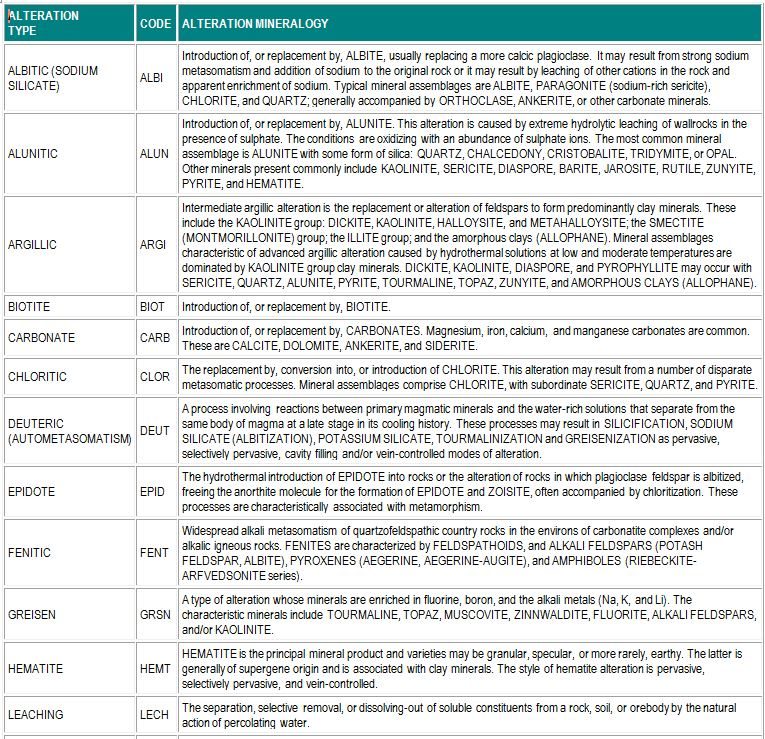
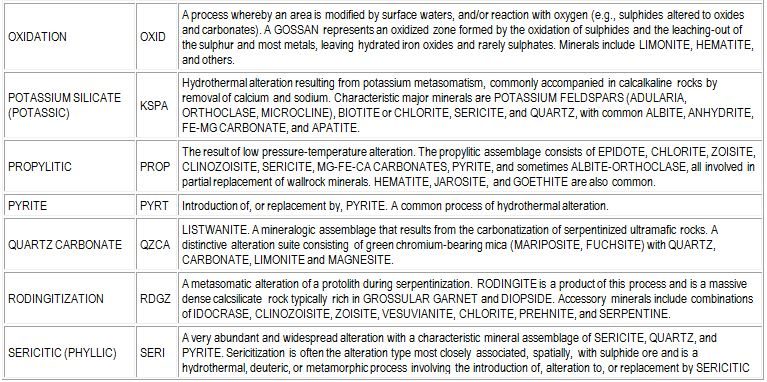
Alteration is a change in mineral composition and chemistry, and can alter the crystal structure and texture of rocks. It is initiated and caused by hot chemically charged hydrothermal fluid circulation and reaction, heat, or friction/pressure, or all combined.
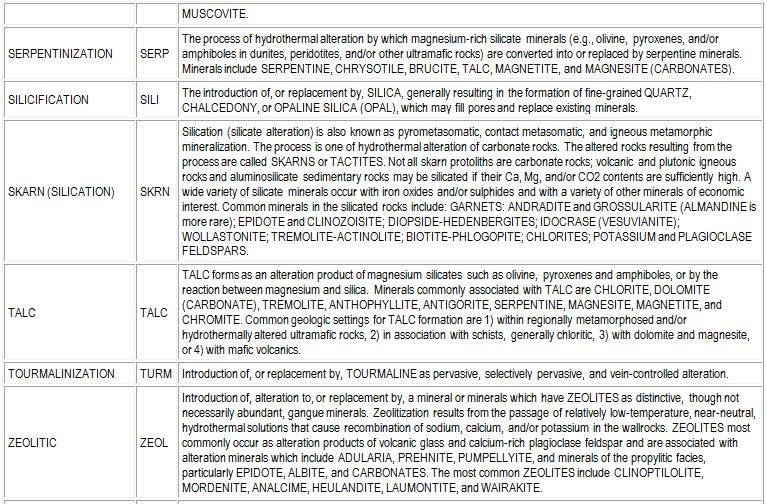
The main types of alteration are as follows.
4.2 Metasomatism
Metasomatism is a process by which solid rock chemical and mineralogical composition is completely changed through simultaneous dissolution and replacement/deposition via chemically reactive circulating hydrothermal fluids. It is a solid state replacement transformation. It commonly happens in the Bushveld Complex where medium grained anorthosite and norite are replaced by ultramafic and mafic metasomatic replacement pegmatites. The replacement takes the form of various sized, irregularly shaped masses within the host rock. The contacts with the host rock are crystal interlocking boundaries, which confirm replacement rather than any type of intrusion.
In metamorphism the bulk chemical composition of rock stays roughly the same, while heat and pressure rearrange the minerals, and add new metamorphic minerals as the grade increases. In metasomatism hot chemically charged hydrothermal fluids actively introduce new chemical components/minerals, completely strip away the existing ones, and change the texture, while the rock remains solid.